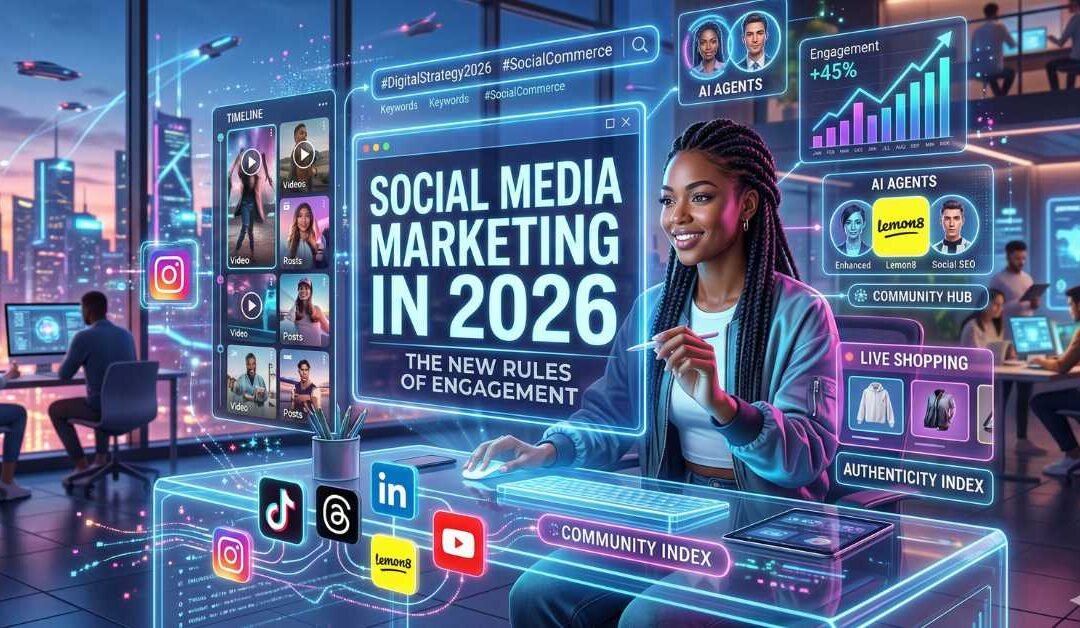
Social media has completely changed. If you are still running your marketing the same way you did in 2023, you are likely falling behind. The landscape of 2026 is no longer about getting the most "likes." It is about understanding how robots (algorithms) discover new things and how humans find deep, real connections.
The days of simply posting a pretty picture are gone. Today, social media is an intricate system of artificial intelligence, search behaviours, and private communities. To succeed, you must move beyond managing simple platforms. You must become a director of an AI-driven environment and a builder of high-trust communities.
This article will break down the latest trends and technologies in social media marketing, explained in simple language so you can start applying them today.
Part 1: The Core Trends Driving Success
The core strategy of how we use social media is shifting. Here are the three main behaviours defining the market right now.
1. Social SEO: Social Media is the New Search Engine
Remember when you used to type everything into Google? For younger generations, especially, that behaviour is changing rapidly. People are now using platforms like TikTok, Instagram, and Reddit as their primary search engines.
Why? Because they want visual proof. They don't want a written list of the "best new pizza place" from an anonymous website. They want to see the pizza, the atmosphere, and a real person eating it. They are searching for reviews, tutorials, and local discoveries directly on social apps.
What This Means for You: Your focus must shift from "going viral" to "being discoverable." When someone searches for a product or service you offer, you need to make sure you show up. This is called Social SEO (Search Engine Optimisation).
How to Do It:
Keywords Everywhere: Use important search terms (keywords) not just in your hashtags, but in your captions and your profile bio.
On-Screen Text: The robots can "read" text overlaid on your videos. Use your keywords in your titles.
Spoken Word: Algorithmic systems listen to what is said. Make sure you clearly speak your main keywords in the first few seconds of your video.
2. The Battle for Authenticity vs. "AI Slop"
We are now living in a world of abundant artificial intelligence. It is incredibly easy to generate "perfect" content. You can make an AI image of a flawless product or an AI-written caption that is technically correct. The problem is, everyone is doing it. This creates a feed full of "AI Slop"—content that looks fine but has no soul.
Because audiences are drowning in this generic content, they are actively looking for something else: the human touch. They are gravitating toward unpolished, real, and imperfect content. A shaky, behind-the-scenes video or a simple meme often performs better than a $10,000 commercial because it signals "human origin."
What This Means for You: You must emphasise the real people behind your brand. Trust is the most valuable currency on social media, and you build it by being human.
How to Do It:
Behind-the-Scenes: Show the messy office, the prototype that failed, or your team having lunch. This feels real.
User-Generated Content (UGC): Encourage your customers to share unedited videos of themselves using your product. This is far more trustworthy than an ad.
Creator-Led Strategy: Move away from paying influencers for one-off posts. Instead, form long-term partnerships with creative people in your niche. Let them be the face of your brand and create content that speaks to their community in their unique voice.
3. Community Over Reach (The Rise of Dark Social)
For years, the goal was simple: get as many people as possible to see your post. In 2026, raw numbers are less important. Why? Because the most active conversations have moved. Public feeds are becoming passive places where people scroll, but they aren't interacting. The "real action" is happening in private.
This is often called "Dark Social" because it is hard for companies to track. It includes:
Direct Messages (DMs).
Group chats on platforms like WhatsApp or Discord.
Instagram Broadcast Channels (one-to-many chats).
People trust the recommendations they get in their DMs far more than they trust a post in their feed.
What This Means for You: You need to stop focusing on how many people you reached and start focusing on how many people you got to talk. You want to encourage private interaction.
How to Do It:
Use DMs: Create content that specifically asks users to "DM me the word [KEYWORD], and I'll send you a special link." This starts a private conversation.
Create Broadcast Channels: This is a great way to talk directly to your superfans and share exclusive information.
Serialized Content (Micro-dramas): Create short stories that are released in parts. This gives users a reason to keep coming back to your page, making your brand feel like a familiar friend rather than a broadcast signal.
Part 2: The New Technologies You Must Understand
If the trends above are the strategy, these technologies are the tools that make that strategy possible.
1. Agentic AI & Embedded Workflows
We have used AI for years, but usually as a simple assistant (like asking ChatGPT to write a caption). Now, we are moving into Agentic AI. This means the AI isn't just a tool; it is an "agent" that can perform entire multi-step jobs on its own.
This AI is embedded directly into marketing systems to manage your workflow.
What This Means for You: It can do the boring, repetitive tasks, freeing you up to be the creative director.
How to Do It:
Automated Scheduling: You give the AI your core concept and a library of images/videos. The AI analyses real-time data to decide the perfect time to post across different platforms, scheduling them all at once.
Multimodal Content: A tool can now take one single idea (like a 3-minute blog post) and automatically turn it into:
A 60-second vertical video (Reel/TikTok style).
A 16:9 widescreen video (YouTube style).
A slideshow post (LinkedIn Carousel style).
The best part? It can do all this while ensuring the visuals (like brand colours and character designs) stay perfectly consistent.
2. Immersive Social Commerce
Online shopping is no longer about seeing a photo and clicking a "link in bio" that takes you to a confusing website. Shopping has now become a single, seamless journey entirely within the social media app.
What This Means for You: You need to make the purchase as easy as possible, reducing any friction that might make a customer change their mind.
How to Do It:
AR & 3D Previews: Augmented Reality (AR) is now standard. Customers can use their phone's camera to do virtual "try-ons" of makeup, eyeglasses, or clothing. They can even place a 3D model of a sofa in their actual living room to see if it fits. This makes people feel more confident to buy and reduces the number of returns.
Live Commerce 2.0: Livestream shopping has evolved. These are now interactive, shoppable broadcasts (like TikTok Shop or Instagram Checkout). A host can demonstrate the product, answer questions in the chat in real-time, and a "buy now" button pops up on the screen. The user buys the product instantly without ever stopping the stream.
3. Conversational AI Commerce
The chatbots of the past were frustrating. They could only understand a few basic commands and often got stuck. The new conversational AI is different. It is powered by Large Language Models (LLMs), similar to how ChatGPT works, but specialised for sales.
What This Means for You: You have a human-like virtual sales assistant working for you 24 hours a day, 7 days a week.
How to Do It:
Deep Personalization: These advanced bots don't just answer FAQs. They can have complex conversations. If a user says, "I'm looking for a gift for my teenage brother who loves video games and dark colors," the AI can offer specific, tailored recommendations.
DMs to Sale: The bot can handle the entire sales process. It answers product questions, provides a personalised suggestion, and completes the entire checkout process right there within the DM or WhatsApp thread.
Part 3: A Quick Look at Key Platforms in 2026
Where you post is just as important as what you post. Here is how the major players fit into the ecosystem.
TikTok (and TikTok Shop): This is the ultimate discovery and commerce platform. The funnel has collapsed: discovery, review, and purchase can all happen in the same 30 seconds.
Instagram: Still a powerhouse for aesthetic content, but it is split between public reels and private interactions. High-trust relationships are built in the DMs and broadcast channels.
LinkedIn: It has completely changed. It is no longer just a place for resumes. It has become a dominant video content platform. Native video posts now see significantly higher engagement (around 5x more) than simple text-only posts.
Threads: This is the conversational layer connected to Instagram. It is currently seeing high growth for text-first, opinion-driven, and quick-response content. It is less polished and more conversational than traditional feeds.
Lemon8: This is gaining traction as a hybrid of Instagram and Pinterest. It focuses on aesthetic, blog-style content about lifestyle and wellness. Think of it as a "visual diary" platform.
Focus on Trust, Led by Tech
The world of social media marketing is always shifting. New tools like AI can write captions, create entire video clips, and manage your schedule. New trends can push you to make more raw videos or to optimise your captions for search.
But amidst all this change, one thing remains true: successful marketing is about human connection.
The technologies listed here are not replacements for your marketing strategy; they are enhancers. Agentic AI doesn't remove the need for creative direction; it frees you from administrative tasks so you can be a director. Live commerce doesn't replace trust; it just provides a faster, easier way for people to buy from a brand they already trust.
The secret to success in 2026 is simple: use technology to be more human, and use algorithms to find the community that has been waiting for you. Focus on building trust, encouraging real conversations, and making your brand easily discoverable. The rest will follow.
In the bustling arena of digital marketing, businesses constantly seek the fastest, most effective path to visibility, engagement, and growth. Two prominent contenders dominate the conversation: Search Engine Optimization (SEO) and Social Media Marketing (SMM). Much like the characters in Aesop's timeless fable, these strategies embody distinct approaches. SMM, the Hare, sprints out of the gate, offering rapid visibility, instant engagement, and quick bursts of attention.1 It thrives on immediacy and interaction. In contrast, SEO plays the role of the Tortoise – methodical, patient, and focused on building a foundation for long-term, sustainable success.3 While SMM's energy is captivating, SEO's endurance promises lasting momentum.5
This report delves into this dynamic, dissecting the fundamental nature of both SEO and SMM. We will analyze their core components, typical timelines, inherent benefits, and unique challenges, framing the discussion within the Tortoise and Hare analogy. By directly comparing their strengths across critical dimensions like speed, cost, longevity, audience intent, and measurement, we aim to illuminate their distinct roles. Furthermore, we will explore the powerful synergy that exists when these two strategies work in concert, examining how social signals can indirectly influence search rankings, how social platforms amplify SEO content, and how social insights refine SEO strategies.
Understanding these individual characteristics and synergistic potential allows for strategic prioritization. We will evaluate scenarios where focusing initially on either the Tortoise or the Hare might be advantageous, depending on specific business goals like a product launch versus establishing foundational authority. Finally, this analysis culminates in actionable strategies for integrating SEO and SMM into a cohesive digital marketing plan. The ultimate objective is not to declare a single winner, but to demonstrate that true victory in the digital marketing race lies in strategically balancing the Hare's speed with the Tortoise's endurance, leveraging quick wins for immediate impact while investing in long-term, compounding growth.
2. Defining the Competitors: SEO and SMM Fundamentals
Before comparing their race strategies, it's essential to understand the core identity of our competitors: SEO, the steady Tortoise, and SMM, the swift Hare. Each operates with distinct objectives and mechanisms within the broader digital marketing ecosystem.
2.1 Search Engine Optimization (SEO): The Steady Tortoise
Search Engine Optimization (SEO) is the systematic practice and process of optimizing websites, webpages, and various forms of digital content (including text, images, videos, and local listings) to improve their visibility and ranking within the organic, or non-paid, results of search engines like Google and Bing.7 It's crucial to distinguish SEO from the broader Search Engine Marketing (SEM); SEO constitutes the organic, unpaid facet of SEM, while paid search (like PPC ads) makes up the other half.8
Core Objectives:
The fundamental goals driving SEO efforts are threefold:
Increase Visibility in SERPs: The primary aim is to rank higher in Search Engine Results Pages (SERPs) for queries relevant to the business's offerings or expertise.7 Given that most users click on the top few results and rarely venture past the first page, achieving high visibility is paramount for capturing user attention.5 The goal isn't necessarily the mythical #1 spot for every query, but rather high visibility for the target audience across relevant searches.7
Drive Qualified Organic Traffic: Higher visibility naturally leads to attracting more visitors who arrive at the website or other digital assets via organic search results.5 This traffic is considered "qualified" because it originates from users actively searching for related information or solutions.
Build Website Authority and Credibility: SEO involves practices that signal to both search engines and users that a website is a trustworthy, authoritative source of information within its niche.15
Fundamental Mechanisms:
SEO operates based on how search engines discover, understand, and rank content:
Crawling: Search engines deploy automated programs known as crawlers, spiders, or bots (like Googlebot) to continuously scan the web, discovering new and updated content by following links.7
Indexing: The discovered content is analyzed and stored in a massive database called an index. If a page is deemed valuable and unique, it's added to the index, making it eligible to appear in search results.9 Pages with duplicate, low-value, or inaccessible content might be excluded.9
Ranking: When a user enters a search query, the search engine's complex algorithms sift through the index to find the most relevant and authoritative pages, ranking them in the SERPs.7 These algorithms consider hundreds of factors and are constantly evolving, incorporating elements like artificial intelligence and machine learning.7
E-E-A-T: Google emphasizes the importance of Experience, Expertise, Authoritativeness, and Trustworthiness (E-E-A-T) when evaluating content quality, particularly for "Your Money or Your Life" (YMYL) topics like finance and health.15 This framework assesses if content is based on first-hand experience, created by a subject matter expert, recognized as authoritative by others (e.g., through links), and factually accurate and trustworthy.15 Trustworthiness is considered the most critical element.7
The intrinsic dependence of SEO on search engine algorithms shapes its character. These algorithms are not static; they undergo thousands of changes annually, ranging from minor tweaks to major core updates.22 This constant evolution means SEO strategies must be adaptable and focused on long-term principles of quality, relevance, and user experience, rather than short-lived tricks designed to exploit temporary loopholes.20 This inherent need to continuously adapt to a changing rulebook reinforces SEO's "slow and steady" nature, demanding persistence and agility – characteristics befitting the Tortoise. The challenge of keeping pace with algorithm updates is a direct consequence of SEO's core mechanism.22
2.2 Social Media Marketing (SMM): The Swift Hare
Social Media Marketing (SMM) encompasses the strategic use of social media platforms—such as Facebook, Instagram, X (formerly Twitter), LinkedIn, TikTok, Pinterest, and others—to achieve business goals.25 These goals typically involve promoting a company's brand, products, or services, engaging directly with current and potential customers, building vibrant online communities, and ultimately driving traffic and sales.10 It's a dynamic facet of digital marketing, sometimes referred to as e-marketing.28
Core Objectives:
SMM campaigns are generally driven by objectives such as:
Increase Brand Awareness and Visibility: Leveraging the vast user bases of social platforms to expose the brand to a wide audience, enhancing recognition and recall.25
Drive Engagement and Build Community: Fostering interaction through likes, comments, shares, and direct messages, creating a loyal community around the brand.25
Generate Leads and Drive Traffic/Conversions: Encouraging users to visit the website, sign up for offers, or make purchases, directly contributing to business growth.28
Provide Customer Service and Gather Feedback: Using platforms as channels for customer support, addressing inquiries, managing reputation, and collecting valuable insights and sentiment.25
Fundamental Mechanisms:
SMM achieves its objectives through several core activities:
Content Creation and Publishing: Developing and distributing content (text, images, videos, stories, live streams) specifically tailored to the nuances and audience preferences of each platform.25 Content pillars or themes often guide this process for consistency.41
Community Engagement and Interaction: Actively participating in conversations, responding to comments and messages, monitoring brand mentions, and fostering a two-way dialogue with the audience.25
Platform Feature Utilization: Leveraging specific features like hashtags for discoverability, stories for ephemeral content, groups for community building, and live video for real-time engagement.25
Paid Social Advertising: Employing targeted advertising options offered by platforms to reach specific demographics, interests, or behaviors, often necessary to overcome declining organic reach.2
Analytics and Measurement: Utilizing built-in platform analytics or third-party tools to track key performance indicators (KPIs), understand audience behavior, and measure the effectiveness of campaigns, allowing for data-driven adjustments.2
The effectiveness of SMM hinges significantly on continuous, active participation within the chosen platforms' ecosystems. Creating engaging content, responding to interactions, and often utilizing paid promotion are not one-time tasks but ongoing necessities.25 This requirement for constant activity 46 is what enables SMM's rapid results – a post can generate engagement almost instantly. However, it also contributes to the ephemeral nature of its impact; unlike an SEO-optimized webpage that can rank and draw traffic for years, the visibility of a social media post often fades quickly unless actively boosted or continually refreshed.2 This reliance on perpetual motion perfectly mirrors the Hare's strategy: fast bursts of speed that require constant energy expenditure.
3. Analyzing the Tortoise: The Long-Term Power of SEO
The Tortoise, representing SEO, moves deliberately, focusing on building a foundation that yields substantial, long-lasting rewards. Its strategy is multifaceted, requiring patience but ultimately leading to sustainable growth and authority in the digital realm.
3.1 Key Components of the SEO Marathon
Achieving success in SEO involves orchestrating several critical components, often referred to as the pillars of SEO.16 These elements work together to signal relevance, authority, and quality to search engines and users alike.
Keyword Research: This is the bedrock upon which effective SEO is built.19 It involves identifying the specific terms and phrases (keywords) that the target audience uses when searching for information, products, or services online. This process goes beyond simply finding popular terms; it requires understanding search intent – the underlying goal behind a query (e.g., is the user looking for information, trying to navigate to a specific site, intending to purchase, or comparing options?).55 Marketers must also analyze search volume (how often a keyword is searched), keyword difficulty (how competitive it is to rank for), and relevance to the business's offerings.13 Tools like Google Keyword Planner, Semrush, and Ahrefs are commonly used for this analysis.13 Identifying less competitive, more specific "long-tail keywords" can often provide easier ranking opportunities.13
On-Page Optimization: This pillar focuses on optimizing the elements within individual web pages to make them more understandable and valuable to both search engines and users.7 Key aspects include:
Content Optimization: Creating high-quality, comprehensive, unique, and fresh content that directly addresses the target keywords and satisfies user search intent.21 Keywords should be used naturally within the text, not "stuffed" artificially.21
Title Tags: Crafting compelling and descriptive page titles (visible in browser tabs and SERPs) that include target keywords and entice clicks, ideally under 60 characters.50
Meta Descriptions: Writing concise summaries (under 160 characters) that appear in SERPs, accurately describing the page content and encouraging click-throughs.50
Header Tags (H1, H2, etc.): Structuring content logically using header tags to improve readability and signal content hierarchy to search engines.50
URL Structure: Creating short, descriptive URLs that include relevant keywords and are easy for users and search engines to understand.8
Internal Linking: Strategically linking relevant pages within the same website to help users navigate, distribute "link equity," and establish topical relationships.8
Image Optimization: Using descriptive file names and alt text for images to help search engines understand visual content and improve accessibility.12
Technical SEO: This involves optimizing the website's backend and infrastructure to ensure search engines can efficiently crawl, index, and render the site, while also providing a positive user experience.7 Core elements include:
Site Architecture: Designing a logical website structure that makes navigation intuitive for users and helps search engines understand content relationships.16
Crawlability: Ensuring search engine crawlers can access all important content, often managed via a robots.txt file.19
Indexability: Helping search engines understand which pages should be included in their index, typically facilitated by an XML sitemap.16
Site Speed & Performance: Optimizing page load times, as both users and search engines prefer fast websites. This includes factors measured by Google's Core Web Vitals (Loading, Interactivity, Visual Stability).8
Mobile-Friendliness: Ensuring the website displays and functions correctly on all devices (desktops, tablets, smartphones) using responsive design, crucial due to mobile-first indexing.8
Security: Using HTTPS encryption to secure the connection between the user and the website.8
Structured Data (Schema Markup): Adding specific code (markup) to HTML to help search engines better understand the context of content (e.g., identifying reviews, events, products), potentially enhancing SERP appearance.8
Off-Page Optimization (Link Building & Authority): This encompasses activities performed outside the website to build its reputation, authority, and trustworthiness.7 The most significant component is:
Link Building: Acquiring high-quality backlinks (links from other websites pointing to your site).9 Search engines view these backlinks as "votes of confidence," signaling that other reputable sources trust your content.11 Emphasis is placed on the quality and relevance of linking domains, rather than just the quantity.11 Manipulative link schemes and low-quality links should be avoided as they can harm rankings.11 Off-page optimization also includes building brand mentions across the web, engaging in public relations, and potentially leveraging social signals (though their direct impact is debated).8 These activities contribute significantly to establishing the E-E-A-T factors search engines value.15
Content Creation: While listed separately, content is inextricably linked to all other pillars, often cited as the most crucial element ("content is king").13 SEO requires a consistent strategy of creating and publishing high-quality, relevant, valuable, and unique content designed to meet user needs and target specific keywords.12 Regularly updating existing content to keep it fresh and accurate is also vital.60 Without compelling content, other SEO efforts have little foundation to build upon.
3.2 The SEO Timeline: Patience Yields Results
A defining characteristic of SEO is its timeline; it is unequivocally a long-term strategy.4 Unlike paid advertising channels like Pay-Per-Click (PPC) or paid social media, which can generate visibility almost instantly upon campaign launch 69, SEO requires patience.
General Expectations: While minor fluctuations might be observed earlier, most experts agree that noticeable, meaningful results from SEO efforts typically begin to manifest within 3 to 6 months.59 Achieving significant impact, substantial rankings for competitive terms, and realizing the strategy's full potential often takes 6 to 12 months, and in highly competitive industries or for brand new websites, it can extend to 12 to 24 months or even longer.59
Factors Influencing the Pace: The journey is not uniform; several factors dictate how quickly results materialize:
Website Age and Authority: Established websites with a history of quality content and a solid backlink profile generally see results faster than new domains.67 New sites often face an initial period of slower ranking progress, sometimes referred to as the "Google Sandbox" effect.67
Industry Competition: The more websites vying for the same keywords and audience, the longer and more challenging it becomes to achieve high rankings.59 Ranking for broad, highly competitive terms takes significantly more time than targeting niche, low-competition keywords.59
Allocated Resources: The budget, expertise of the SEO team (in-house or agency), and the capacity for consistent effort significantly influence the timeline.24 More resources generally allow for faster implementation and potentially quicker results.
Website's Technical Health: A website plagued by technical issues (slow speed, crawl errors, poor mobile experience) will hinder SEO progress. Conversely, addressing technical problems can sometimes lead to relatively quick improvements in performance and rankings.59
Content Quality and Velocity: The quality, relevance, and consistency of content creation and optimization are paramount.65 A robust content strategy accelerates progress.
Link Building Effectiveness: Building high-quality backlinks is a time-consuming but critical process. It can take several months (e.g., 3-4 months) just for link acquisition efforts to start showing a measurable impact on authority and rankings.66
Scope of the Project: The size of the website and the extent of optimization required (e.g., number of pages to optimize, need for site restructuring) naturally affect the timeline.71
A Phased Journey: The SEO process typically unfolds in stages, reinforcing its methodical nature 67:
Content Creation & Off-Page Scaling (Months 3-6+): Developing new content, optimizing existing pages, initiating link building campaigns, local SEO efforts (if applicable). Initial ranking improvements may start appearing.
Ongoing Optimization & Growth (Months 6+): Continuous content creation to build topical authority, ongoing link building, performance monitoring (analytics), conversion rate optimization (CRO), and adapting strategy based on results and algorithm changes.
This phased approach underscores why SEO is a marathon, not a sprint.68 It involves building momentum step by step, requiring sustained effort and investment.
3.3 Enduring Benefits: Why Slow and Steady Wins
The patience required for SEO is rewarded with significant, long-lasting benefits that form the bedrock of a sustainable digital presence.
Sustainable Organic Traffic: Perhaps the most significant benefit is the generation of continuous, "free" website traffic once rankings are achieved.5 Unlike paid advertising, where traffic ceases the moment budget is cut, well-ranked organic content continues to attract visitors passively.6 Organic search is a major driver of overall website traffic for many businesses.5
Increased Authority and Credibility: Consistently appearing high in search results builds trust and establishes the brand as an authority in its field.5 Users inherently trust organic listings more than paid advertisements, perceiving them as more credible and relevant.6 This aligns with and reinforces the E-E-A-T signals valued by search engines.18
Higher Return on Investment (ROI) Over Time: While SEO demands an initial investment of time and resources, it frequently delivers the highest long-term ROI compared to other digital marketing channels.5 The cost per lead acquired through SEO is often significantly lower than outbound marketing methods.75 This is due to the compounding effect of SEO efforts – established rankings and content continue to generate value over time without proportional increases in cost.65
Lasting Visibility & Brand Recognition: SEO builds a durable and resilient online presence.6 High rankings provide continuous exposure for the brand, ensuring it's visible when potential customers are actively searching.17 This consistent visibility reinforces brand recognition.
Improved User Experience (UX): The pursuit of higher rankings often necessitates improvements that directly benefit the user experience. Optimizing for site speed, mobile-friendliness, intuitive navigation, and creating high-quality, readable content are all core SEO practices that make a website more enjoyable and effective for visitors.5
Better Quality Leads & Higher Conversion Rates: SEO targets users who are actively searching for specific information, products, or solutions, indicating a higher level of intent.2 This results in more qualified leads who are often further down the purchase funnel and more likely to convert compared to traffic from passive channels like display ads or general social media browsing.5
3.4 Navigating the Hurdles: SEO Challenges
Despite its powerful long-term benefits, the path of the SEO Tortoise is not without obstacles. Understanding these challenges is crucial for setting realistic expectations and navigating the journey effectively.
Time Investment & Patience Required: The most fundamental challenge is the inherent delay in seeing results.4 SEO demands significant upfront effort and continuous maintenance, and the payoff is not immediate. This can be a source of frustration for stakeholders accustomed to the quicker feedback loops of paid media or SMM.24
Algorithm Updates: Search engines, particularly Google, frequently update their ranking algorithms.22 These updates can range from minor tweaks to major overhauls that significantly impact rankings and traffic, sometimes unpredictably. Staying informed and adapting strategies requires constant vigilance and agility.23 The increasing role of AI in search algorithms adds another layer of complexity.62
Complexity & Evolving Landscape: SEO is a multifaceted discipline involving technical expertise, content strategy, link acquisition, and analytics.7 The best practices are constantly evolving with new technologies (like voice and visual search) and changing user behaviors, demanding continuous learning.22
Intense Competition: In most industries, the digital space is crowded. Many competitors are actively investing in SEO, making it challenging to rank for valuable, high-volume keywords.13 Achieving and maintaining top positions requires significant effort and differentiation.
Resource Intensity: Effective SEO is not free, despite driving "organic" traffic. It requires investment in skilled personnel (in-house or agency), sophisticated tools (for research, audits, tracking), quality content creation, and potentially outreach for link building.24 Budget constraints can significantly slow down progress.24
Measurement & Proving ROI: While the long-term ROI is often high, attributing specific business outcomes (like sales) directly to SEO efforts can be complex, especially given the long customer journeys and multiple touchpoints involved. Forecasting results accurately is also notoriously difficult.24
These very challenges—the need for patience, the complexity, the constant adaptation to algorithm shifts, the resource requirements—are what firmly establish SEO as the Tortoise. Success is not achieved through shortcuts or bursts of speed but through persistent, strategic investment in quality, technical soundness, and authority building over the long haul.18 It demands resilience and a commitment to continuous improvement, mirroring the fable's lesson that slow, steady, and adaptable wins the race.
4. Analyzing the Hare: The Short-Term Sprint of SMM
In contrast to SEO's deliberate pace, Social Media Marketing (SMM), the Hare, thrives on speed, immediacy, and dynamic interaction. Its approach focuses on capturing attention quickly and fostering engagement within the fast-moving social landscape.
4.1 Key Components of the SMM Dash
A successful SMM strategy involves several interconnected components designed to maximize impact on social platforms.25
Strategy & Planning: This foundational stage involves defining clear, measurable goals (often using the SMART framework: Specific, Measurable, Achievable, Relevant, Time-bound) that align with overall business objectives.25 It includes identifying the target audience through buyer personas 28 and selecting the most appropriate social media platforms where this audience is active.26 Planning also involves developing a content calendar and defining core themes or "content pillars" to ensure consistent messaging.28
Platform Selection: Choosing the right mix of social media platforms is critical. Different platforms cater to different demographics and content types (e.g., Instagram and TikTok for visual, younger audiences; LinkedIn for B2B professionals; Facebook for broad reach and community features).25 Understanding that the average user engages with multiple platforms 85 allows for strategic cross-platform presence.
Content Creation & Curation: This is the heart of SMM. It involves producing a steady stream of engaging content tailored to each platform's format and audience expectations. This includes text updates, high-quality images, compelling videos (especially short-form), interactive stories, and live streams.25 Curating and sharing relevant content from other sources can also add value.40 Visual appeal is often paramount.42
Community Engagement & Listening: SMM is inherently a two-way street. Actively engaging with the audience by responding to comments and messages, participating in relevant conversations, monitoring brand mentions, and addressing feedback (both positive and negative) is crucial for building relationships and community.25 Social listening tools help track these conversations and gauge sentiment.26
Paid Social Advertising: Given the challenges of organic reach on many platforms, paid advertising is often a necessary component. This involves using the platforms' sophisticated ad tools to target specific demographics, interests, or behaviors, boost the visibility of posts, and drive specific actions like website visits or conversions.1 The social ad market represents a significant and growing investment area for businesses.85
Analytics & Reporting: Measuring performance is vital for refining strategy. SMM involves tracking key performance indicators (KPIs) such as reach (unique viewers), impressions (total views), engagement rate (likes, comments, shares relative to reach/impressions), click-through rate (CTR), follower growth, conversion rates, and sentiment analysis.2 Both platform-native analytics and third-party management tools (like Hootsuite, Sprout Social, Buffer) provide these insights.26
4.2 The Need for Speed: Rapid Visibility and Engagement
SMM's primary advantage lies in its immediacy and potential for rapid impact, embodying the Hare's quick start.
Immediacy: Unlike SEO, which requires time for crawling, indexing, and ranking, social media allows for instant content publication and real-time interaction.1 Engagement metrics like likes and comments can appear within minutes of posting, providing immediate feedback.78 This makes SMM significantly faster than SEO in generating initial visibility and interaction.2
Viral Potential: Highly engaging, shareable, or emotionally resonant content has the potential to spread rapidly through user shares and platform algorithms, reaching vast audiences far beyond the brand's initial followers in a short period.28
Trend Responsiveness: The real-time nature of social media enables brands to quickly capitalize on emerging trends, participate in timely conversations, and maintain relevance in a fast-paced cultural landscape.25
Quick Wins: SMM is particularly well-suited for achieving short-term objectives, such as promoting a limited-time offer, announcing a product launch, driving attendance to an event, or generating immediate buzz around a campaign.1 Paid advertising can further accelerate these quick wins.1
4.3 Quick Wins: The Benefits of SMM
The speed and interactive nature of SMM translate into several tangible benefits for businesses.
Increased Brand Awareness & Visibility: SMM provides unparalleled access to large and diverse audiences, allowing brands to quickly amplify their presence and increase recognition.25 Consistent posting keeps the brand top-of-mind.
Direct Audience Engagement & Relationship Building: Social platforms facilitate direct, two-way communication between brands and consumers.25 Responding to comments, answering questions, and participating in conversations fosters a sense of connection, builds trust, and cultivates loyalty.25 This is particularly important for building trust with younger demographics like Gen Z.25
Community Building: SMM enables brands to create dedicated spaces (like groups or forums) and foster a community of loyal customers, fans, and advocates around shared interests related to the brand.26
Rapid Feedback & Market Insights: The interactive nature allows for immediate feedback on products, services, or content.38 Social listening and sentiment analysis provide real-time insights into customer opinions, market trends, and competitor activities.25
Website Traffic Spikes: Sharing links to website content, landing pages, or product pages within social posts, bios, and ads can drive significant referral traffic, potentially leading to sharp increases (spikes) in website visitors.27 Social media is recognized as a significant traffic source in web analytics.99
Lead Generation & Sales: SMM can directly contribute to lead generation and sales through targeted advertising, compelling calls-to-action, influencer collaborations, and increasingly, integrated social commerce features (e.g., Instagram Shopping, TikTok Shop).25 Many consumers now use social platforms for product discovery and purchasing.97
Potential Cost-Effectiveness: Organic SMM can be initiated with a relatively low budget, focusing on creative content and engagement.28 Paid social advertising, while requiring investment, offers highly targeted options that can lead to efficient customer acquisition if managed well.28
4.4 Potential Pitfalls: SMM Challenges
The Hare's speed comes with its own set of challenges and potential drawbacks that businesses must navigate.
Constant Effort Required: Maintaining momentum on social media demands relentless, consistent effort in content creation, posting schedules, community management, and monitoring.28 It is inherently time-consuming, and neglecting activity can lead to a rapid decline in visibility and engagement.28
Algorithm Changes & Unpredictability: Social media platforms frequently update their algorithms, which control content visibility.28 These changes can significantly impact organic reach, often reducing it, forcing brands to adapt strategies or increase paid spend to maintain visibility.46 This makes long-term planning challenging.
Measuring Direct ROI: While engagement metrics are readily available, attributing tangible business outcomes like sales directly to specific SMM activities can be difficult.28 The path from social interaction to conversion is often indirect, making ROI justification a common challenge.
Negative Feedback & Reputation Management: The public and real-time nature of social media means that negative comments, complaints, or brand crises can spread rapidly and widely, potentially causing significant reputational damage if not managed promptly and effectively.28
Content Saturation & Noise: The sheer volume of content published on social media makes it increasingly difficult for brands to stand out and capture audience attention.23 Users can also experience "ad fatigue" if exposed to repetitive promotions.47
Platform Dependency: Relying heavily on one or two social platforms carries inherent risks. Algorithm changes, shifts in platform popularity, or policy updates can significantly disrupt a brand's strategy and reach.46
Resource Intensity (Time & Creativity): While initial costs might seem low, effective SMM requires significant time investment from skilled professionals, continuous creative ideation, content production resources, and often, a budget for paid advertising.46 Finding and retaining qualified social media talent is also a recognized challenge.100
The "quick wins" offered by SMM are intrinsically tied to this need for perpetual motion. Unlike SEO, where optimized content can become a long-term asset generating traffic passively, SMM's visibility often requires continuous fuel – be it new content, active engagement, or ad dollars.2 The moment the sprinting stops, the Hare's progress often halts abruptly, highlighting the trade-off between speed and sustainability.
5. Head-to-Head: SEO (Tortoise) vs. SMM (Hare) Compared
Having analyzed the individual characteristics of SEO (the Tortoise) and SMM (the Hare), we can now place them side-by-side, directly comparing their approaches and outcomes across key strategic dimensions.3 This comparison illuminates why a nuanced understanding of both is crucial for effective digital marketing.
Dimension 1: Speed vs. Endurance
SMM (Hare): Excels in speed. It delivers rapid visibility, immediate engagement opportunities, and quick feedback loops.1 This makes it ideal for short-term campaigns, product launches, event promotions, and capitalizing on current trends.2 However, these results are often tied directly to ongoing activity and promotion levels.2
SEO (Tortoise): Embodies endurance. It requires significant patience, as measurable results build gradually over months, sometimes years.4 The focus is on constructing a sustainable, long-lasting online presence that consistently attracts organic traffic over time.6
Dimension 2: Initial Investment vs. Long-Term Cost
SMM (Hare): Can be initiated with relatively low upfront costs, particularly with organic posting strategies.31 However, achieving significant reach and maintaining visibility often necessitates continuous investment in paid advertising and substantial resource allocation for content creation and active management.28 The results from paid social media typically cease when the ad spend stops.6
SEO (Tortoise): Generally requires a more substantial upfront investment in terms of time, technical expertise, in-depth content creation, and strategic link building efforts.31 However, once strong organic rankings are achieved, the cost per acquisition tends to decrease significantly, as traffic continues to flow without direct payment per click or impression.6 This often leads to a higher long-term ROI.5
Dimension 3: Result Longevity
SMM (Hare): The impact of individual social media posts is typically short-lived. Content visibility fades quickly in fast-moving feeds unless continually promoted or exceptionally viral.2 Success is heavily dependent on current platform algorithms and audience trends.
SEO (Tortoise): The results of successful SEO are durable. High rankings for relevant keywords, particularly with evergreen content, can drive consistent organic traffic for months or even years with ongoing maintenance.5 SEO builds lasting digital assets for the business.
Dimension 4: Audience Intent
SMM (Hare): Primarily engages users who are in a passive state of browsing, socializing, or seeking entertainment.2 Targeting relies on demographics, interests, past behaviors, and connections rather than immediate search needs.2 It's effective for building brand awareness, fostering community, and reaching audiences who may not yet be actively looking for a solution.
SEO (Tortoise): Directly targets users exhibiting active search intent – they are deliberately using search engines to find specific information, compare products, or solve a problem.2 This means the audience reached through SEO is often highly qualified and closer to making a decision or conversion.5 This difference in intent is a crucial strategic distinction, explaining why SEO, despite its slower pace, often yields higher-quality leads and better conversion rates.17 The user is actively seeking, making them more receptive to relevant solutions found via search.
Dimension 5: Measurement Metrics
SMM (Hare): Success is often measured through metrics focused on visibility and interaction within the platform itself. Key indicators include reach, impressions, engagement rate (likes, comments, shares), follower growth, brand mentions, click-through rates (on links/ads), and sentiment analysis.2 Directly attributing revenue or proving definitive ROI can be challenging.28
SEO (Tortoise): Metrics are typically more closely tied to website performance and business outcomes. Key indicators include organic traffic volume, keyword rankings, conversion rates (leads, sales, sign-ups), lead quality, bounce rate, time on page, and ultimately, return on investment.2 The connection to bottom-line results tends to be clearer, albeit over a longer timeframe.
Table: SEO (Tortoise) vs. SMM (Hare) - A Comparative Overview
Dimension
SEO (Tortoise)
SMM (Hare)
Speed to Results
Slow (Months to Years) 67
Fast (Days to Weeks) 2
Endurance/Longevity
High (Lasting Rankings/Traffic) 17
Low (Ephemeral Content, Needs Constant Effort) 2
Investment Focus
Upfront (Technical, Content, Links) 65
Ongoing (Content Creation, Ads, Management) 46
Long-Term Cost
Potentially Lower (Organic Traffic is "Free") 6
Potentially Higher (Ongoing Ad Spend/Resources) 28
This direct comparison highlights that neither strategy is inherently superior; they serve different purposes and excel under different conditions. The Tortoise builds a lasting foundation, while the Hare generates immediate excitement.
6. Beyond Competition: The Synergistic Power Couple
While the "versus" framing helps clarify their differences, the true power in digital marketing often lies not in choosing one over the other, but in harnessing their complementary strengths.88 SEO and SMM, when integrated, form a synergistic partnership where each enhances the effectiveness of the other.
6.1 Social Signals and SEO: An Indirect Relationship
One of the most discussed, and sometimes debated, aspects of the SEO-SMM relationship revolves around "social signals" – metrics like likes, shares, comments, and follower counts on social media platforms.107
The Official Stance vs. Correlation: Google has consistently stated that social signals are not a direct factor in their ranking algorithms.99 They don't simply count likes or shares to determine page rank. However, numerous studies and expert observations point to a strong correlation between robust social media activity and higher search rankings.63 Some alternative search engines, like Bing, have indicated they do consider social signals more directly.109
Mechanisms of Indirect Influence: This correlation arises because strong social media performance indirectly boosts factors that are important for SEO 63:
Increased Content Visibility and Amplification: When content is shared widely on social media, it reaches a larger audience than it might through search alone. This increased exposure can lead to more people discovering the content.99
Referral Traffic Generation: Clicks on links shared via social media drive traffic directly to the website. While this referral traffic itself isn't a direct ranking factor, it can positively influence user engagement metrics (like time on site, pages per session, lower bounce rates) that search engines may interpret as signals of content quality and user satisfaction.99
Natural Link Building Opportunities: Greater visibility through social sharing increases the likelihood that bloggers, journalists, website owners, or influencers will discover the content and link back to it from their own sites.63 These earned, natural backlinks are a powerful SEO ranking factor. Social media can also be used proactively for link building outreach.118 While most links directly from social media posts or profiles are "nofollow" (meaning they don't pass direct SEO authority), they are still valuable for driving traffic.112
Enhanced Brand Authority and Trust: A strong, active social media presence builds brand recognition, credibility, and trust.63 This can lead to an increase in branded searches (users searching directly for the brand name), which is a positive signal for search engines.113 Familiarity with a brand seen on social media might also increase the click-through rate (CTR) when its listing appears in SERPs.125 Furthermore, social media profiles themselves often rank prominently in search results for branded queries, occupying valuable SERP real estate and reinforcing brand presence.44
Potentially Faster Indexing: Some evidence suggests that significant social buzz around new content might encourage search engine crawlers to discover and index it more quickly.128
Therefore, while Google may not directly count likes, the cumulative effect of increased visibility, traffic, engagement signals, link opportunities, and brand recognition generated through social media activity creates a powerful indirect boost to SEO performance. Neglecting social media means foregoing these significant amplification and authority-building opportunities.
6.2 Promoting SEO Content on Social Platforms
One of the most direct ways SEO and SMM work together is using social media as a distribution channel for content created primarily for SEO purposes.
Content Distribution Hub: Social media platforms are ideal channels for sharing and promoting website content like blog posts, articles, guides, case studies, infographics, and videos.63 This immediately exposes the content to an existing audience.
Extending Content Lifespan: Sharing content on social media gives it an initial visibility boost and can help resurface older, evergreen content, driving continued traffic long after its original publication date.111
Content Repurposing for Wider Reach: SEO-focused content (often long-form text) can be effectively repurposed into various formats suitable for different social platforms. For example, a detailed blog post can become a series of engaging tweets, an Instagram carousel, a short explanatory video for TikTok or Reels, or a visually appealing infographic for Pinterest.99 This maximizes the value derived from the original content creation effort and caters to diverse audience preferences.
Driving Targeted Traffic to SEO Assets: Crafting compelling social media posts with clear calls-to-action (CTAs) can effectively direct users from social platforms to specific, optimized pages on the website, such as cornerstone content pieces, service pages, product pages, or dedicated landing pages.103
6.3 Using Social Insights for Keyword Research & Content Strategy
The synergy also flows in the opposite direction, with insights gleaned from social media actively informing and improving SEO strategies.
Discovering Audience Language and Keywords: Social listening – monitoring conversations on social media platforms – provides invaluable insights into how the target audience naturally discusses relevant topics, products, services, and pain points.92 This uncovers authentic keyword ideas, including long-tail phrases and conversational queries that might be missed by traditional keyword tools, and helps understand the nuances of search intent.116
Identifying Content Gaps and Hot Topics: By tracking trending topics, frequently asked questions, and discussions within relevant communities or hashtags, social listening helps identify content gaps and emerging areas of interest.25 This allows for the creation of timely, relevant SEO content that resonates with current audience needs.
Deepening Audience Understanding: Social media analytics offer rich demographic, interest, and behavioral data about the people engaging with the brand.92 This information can be used to refine buyer personas, leading to more targeted and effective SEO content and strategies.
Validating Content Performance: Analyzing which content formats and topics generate the most engagement (shares, comments, discussions) on social media provides direct feedback on what resonates with the audience.92 This feedback loop can guide future SEO content creation, prioritizing topics and formats proven to capture interest.
This flow of information from social media back to SEO strategy is a potent aspect of integration. It allows SEO to become more dynamic, audience-centric, and responsive to real-time market conversations, moving beyond static keyword data to incorporate genuine user language and interests. Establishing these feedback loops, where social listening and analytics actively inform SEO decisions, is key to unlocking true synergy.
7. Strategic Prioritization: When to Lead with the Tortoise or the Hare
While the ideal scenario involves integrating SEO and SMM seamlessly, practical constraints like limited budgets, time pressures, or specific campaign goals often necessitate prioritizing one channel over the other, at least initially.2 The decision on whether to lead with the Tortoise's steady build or the Hare's quick sprint should align directly with overarching business objectives.28
Scenario 1: New Business/Startup (Limited Budget/Time)
Goal: Establish initial market presence, generate awareness, gather feedback quickly on a tight budget.
SMM Focus (Hare): SMM, particularly organic efforts, can offer faster initial visibility and community building with potentially lower upfront financial costs compared to a full SEO build-out.31 It allows for direct interaction with early adopters and rapid feedback collection. Paid social can provide targeted reach even with a small budget.1
SEO Support (Tortoise): Concurrently, foundational SEO work should begin. This includes setting up a technically sound website, optimizing core pages (homepage, about, contact), and establishing local SEO profiles (like Google Business Profile) if applicable, as local SEO can yield quicker results.59
Rationale: SMM provides the immediate buzz needed to get off the ground, while foundational SEO starts building the necessary long-term asset.
Scenario 2: Product Launch or Event Promotion
Goal: Generate maximum awareness, excitement, and conversions (registrations, pre-orders, ticket sales) within a specific, often short, timeframe.
SMM Focus (Hare): SMM is perfectly suited for creating immediate buzz, leveraging urgency, and driving rapid action through targeted advertising, influencer collaborations, engaging content (videos, countdowns), and real-time updates.2
SEO Support (Tortoise): Create a dedicated, SEO-optimized landing page for the product launch or event. This page serves as the central information hub, captures leads/sales, and provides a long-term discoverable asset for related searches even after the initial buzz fades.
Rationale: SMM delivers the necessary speed and reach for a time-sensitive launch, while SEO provides the essential destination and lasting information source.
Scenario 3: Building Long-Term Authority & Lead Generation (Especially B2B)
Goal: Establish credibility as an industry expert, generate high-quality leads for a complex product/service with a long sales cycle, build sustainable traffic.
SEO Focus (Tortoise): SEO excels in this domain. It allows the business to attract users actively researching solutions by ranking for high-intent, often niche or technical keywords.144 Creating in-depth, authoritative content (whitepapers, case studies, detailed guides) builds credibility and nurtures leads over the typically longer B2B sales cycle.17
SMM Support (Hare): Use platforms like LinkedIn to promote the authoritative content, engage with industry professionals, participate in relevant groups, and build relationships with key decision-makers.146
Rationale: SEO directly addresses the research-intensive nature of B2B buying and builds the necessary long-term trust, while SMM acts as an important amplification and networking tool.
Scenario 4: Driving E-commerce Sales (B2C)
Goal: Increase online sales, drive traffic to product pages, capture impulse buys, build brand loyalty among consumers.
SEO Focus (Tortoise): Essential for ranking product and category pages for relevant transactional keywords ("buy running shoes," "red dresses size 10"), capturing shoppers actively looking to purchase.142 Provides a steady stream of high-intent traffic.
SMM Focus (Hare): Powerful for visual product discovery (Instagram, Pinterest), building brand awareness and desire, running targeted ad campaigns for specific products or promotions, leveraging influencer marketing, facilitating impulse purchases through social commerce features, and running flash sales.79
Rationale: Strong integration is vital. SEO provides the foundation for discoverability via search, while SMM drives awareness, engagement, visual appeal, and time-sensitive promotions. Prioritization might shift based on product lifecycle, seasonality, or specific campaign goals.
Scenario 5: Brand Building & Community Focus
Goal: Foster a strong brand identity, build a loyal community, enhance customer relationships, showcase brand personality and values.
SMM Focus (Hare): SMM is the natural leader here. It's designed for direct engagement, two-way conversation, community management, and showcasing brand personality authentically.25 It's ideal for building loyalty, encouraging user-generated content, and creating brand advocates.33
SEO Support (Tortoise): Ensure the brand name ranks prominently in search results (Brand SERP optimization). Optimize website content that reflects and supports the community's values and interests. Ensure the website provides a good user experience for referred social traffic.
Rationale: SMM directly facilitates the desired interactions and community building, while SEO ensures the brand is easily found and the website supports the community experience.
Table: Prioritizing SEO vs. SMM Based on Business Goals
SEO for Search Intent, SMM for Awareness & Promotion 97
Brand Building & Community Focus
Engagement, Loyalty, Brand Personality, Advocacy
SMM (Hare)
SEO for Brand Visibility & Website Support 25
It is important to recognize that "prioritization" in these scenarios often refers to the allocation of the majority of initial or incremental resources, not the complete exclusion of the other channel.88 Even when launching with SMM, an optimized landing page (SEO) is vital. When focusing on B2B SEO, social media promotion remains crucial for content amplification.148 A truly effective strategy usually involves elements of both, with the balance shifting based on immediate needs and long-term objectives.
8. Integrating for Victory: Crafting a Cohesive Digital Marketing Plan
The ultimate goal is not to pit the Tortoise against the Hare, but to have them run different legs of the same relay race, working together towards the finish line.3 A cohesive digital marketing plan integrates SEO and SMM, ensuring their efforts are aligned and mutually reinforcing.103 This section outlines practical steps for achieving this integration.
8.1 Practical Steps for Integration
Moving from the 'why' to the 'how', several actionable steps can help businesses weave SEO and SMM into a unified strategy:
Unified Strategy & Goal Alignment: The process begins with ensuring that both SEO and SMM activities are driven by and contribute to overarching business objectives.25 This requires clear communication and collaboration between teams or individuals responsible for each channel, fostering a shared understanding of goals and target audiences.103 Regular meetings and shared reporting dashboards can facilitate this alignment.
Keyword Integration: Leverage the insights from SEO keyword research to inform social media content strategy. Incorporate relevant keywords naturally into social media posts, hashtags, profile descriptions, and image alt text.44 Conversely, use social listening to discover the natural language and trending terms your audience uses, feeding this back into SEO keyword strategies.98 Maintain consistent language and terminology across both channels.103
Aligned Content Strategy: Develop a content calendar that strategically plans for both the creation of SEO-focused assets (like pillar pages, in-depth blog posts) and the subsequent promotion and repurposing of that content for social media channels.61 Create "link-worthy" or "link bait" content – such as original research, comprehensive guides, or compelling infographics – that is valuable for SEO and highly shareable on social platforms.99
Comprehensive Profile Optimization: Treat social media profiles as important digital assets. Ensure they are fully completed with accurate and consistent business information (including Name, Address, Phone - NAP - for local SEO). Optimize bios and descriptions with relevant keywords and include clear links back to the main website or relevant landing pages.44 Use sameAs Schema markup on the website to explicitly connect the site to official social profiles for search engines.132
Strategic Cross-Promotion: Actively promote SEO-driven content (blog posts, guides, landing pages) across relevant social media channels to drive traffic and amplify reach.103 Conversely, embed social media feeds or posts on the website where relevant, and prominently display social sharing buttons on website content to encourage visitors to share.63 Ensure social profiles and posts strategically link back to relevant website pages.63
Leverage Social Media for Link Building: Beyond hoping for natural links from social shares, proactively use social media for link building. Engage with influencers, journalists, bloggers, and industry peers on social platforms to build relationships that can lead to guest posting opportunities or backlinks.98 Share high-value content strategically to attract attention from potential linkers.118
Consistent Branding & Messaging: Maintain a unified brand voice, visual identity, tone, and core messaging across all SEO content and social media interactions. This consistency builds brand recognition and trust.44
8.2 Using Social Analytics to Inform SEO Strategy
A crucial element of successful integration is establishing feedback loops where data gathered from social media actively informs and refines SEO strategy. Social analytics offer a rich source of real-time audience intelligence that extends far beyond the social media team.
Identify Resonant Topics: Analyze social media engagement metrics (likes, shares, comments, saves) to identify which content topics, themes, and formats resonate most strongly with the audience. This data provides valuable validation for existing SEO content and inspiration for new topics likely to perform well in search.106
Understand Audience Language: Social listening tools and comment analysis reveal the precise language, terminology, questions, and pain points expressed by the target audience in their own words.92 This provides authentic keyword ideas and helps frame SEO content in a way that directly addresses user needs and search intent.
Track Social Referral Behavior: Use web analytics platforms like Google Analytics to monitor the traffic coming from different social media channels. Analyze how these visitors behave on the website: Which pages do they visit? How long do they stay? Do they convert? This data helps understand the quality of traffic from each platform and identify opportunities to optimize both the social promotion strategy and the website landing pages for better engagement and conversion.99
Gain Competitor Intelligence: Monitoring competitors' social media activities, content performance, and audience engagement provides insights into their strategies, successes, and potential weaknesses, informing your own SEO and content approach.25
Refine Buyer Personas: Social media platforms provide detailed demographic and interest data about followers and engaged users. This information can be used to enrich and validate buyer personas, leading to more accurate targeting in SEO keyword research and content creation.92
By systematically collecting, analyzing, and sharing insights from social media analytics with those responsible for SEO, businesses can create a more dynamic, responsive, and audience-focused search strategy.
9. Conclusion: Winning the Race with a Balanced Strategy
The digital marketing landscape, much like Aesop's fable, presents a choice between the rapid sprint of the Hare (SMM) and the persistent marathon of the Tortoise (SEO). SMM offers the allure of immediate visibility, real-time engagement, and the potential for viral reach, making it invaluable for building brand awareness, fostering community, and driving quick wins. However, its impact often requires constant effort and can be ephemeral, dependent on ever-changing platform algorithms and ongoing activity.
Conversely, SEO embodies endurance. It's a methodical, long-term investment focused on building a sustainable foundation of organic traffic, authority, and credibility. While demanding patience and significant upfront effort, successful SEO yields durable results, attracts high-intent users, and often delivers a superior long-term return on investment.
The analysis reveals that declaring one definitively "better" than the other is a flawed premise. The most successful digital marketing strategies recognize the distinct strengths and weaknesses of both the Tortoise and the Hare and integrate them intelligently.77 True victory lies not in choosing speed or endurance, but in achieving a strategic balance between them.
An integrated approach leverages the speed and reach of SMM to amplify SEO content, build brand awareness, engage audiences, and gather valuable real-time insights. Simultaneously, it invests in the foundational power of SEO to capture active search intent, build lasting authority, drive qualified traffic, and generate sustainable growth. Social insights inform SEO strategy, while SEO content provides substance for social promotion, creating a powerful, synergistic cycle.
Businesses should therefore audit their current digital marketing mix, assess their specific goals, understand their target audience's behavior across channels, and evaluate their available resources. Based on this assessment, they can determine the optimal balance and integration points between SEO and SMM. Whether prioritizing SMM for a launch while building SEO foundations, or leading with SEO for long-term authority while using SMM for amplification, the key is a holistic view. By embracing both the Hare's agility and the Tortoise's persistence, organizations can craft a comprehensive digital strategy that delivers both immediate impact and enduring success in the ever-evolving race for online relevance.
Social Listening: an Exhaustive Guide to Generating Relevant Content Ideas Using Social Media - Nightwatch.io, accessed on April 9, 2025, https://nightwatch.io/blog/social-listening/
In today's digital age, it's crucial to go beyond traditional advertising and tap into the power of influencer marketing and user-generated content (UGC). By leveraging these strategies, you can significantly amplify your social media reach and connect with your target audience in a more authentic and impactful way.
What are the Benefits of Influencer Marketing and UGC?
Building Trust and Loyalty: By partnering with credible influencers, you can build trust with your audience and foster stronger brand loyalty.
Extending Your Reach: Influencers can help you reach new audiences and expand your brand's visibility.
Providing Social Proof: UGC can showcase real people using and enjoying your products or services, increasing credibility.
Optimizing Your Budget: By utilizing UGC, you can create cost-effective marketing campaigns.
Direct Connection with Your Audience: Engaging with your audience through UGC fosters a sense of community and loyalty.
Boosting SEO: High-quality UGC can improve your website's search engine ranking.
Bypassing Ad Blockers: UGC often bypasses ad blockers, ensuring your message reaches your target audience.
How Can I Implement Influencer Marketing and UGC Strategies?
Identify Your Target Audience: Clearly define your target audience to identify the right influencers who align with your brand values.
Set Clear Goals: Determine what you want to achieve with your influencer marketing campaign, whether it's increasing brand awareness, driving sales, or generating leads.
Select the Right Influencers: Choose influencers who have a genuine interest in your brand and whose audience aligns with your target market.
Develop a Strong Campaign Strategy: Create a well-defined campaign strategy, including content guidelines, timelines, and performance metrics.
Encourage User-Generated Content: Use social media contests, hashtags, and other creative incentives to encourage your audience to share their experiences with your brand.
Monitor and Engage: Actively monitor social media conversations and engage with your audience, responding to comments and messages promptly.
Measure Your Results: Track the performance of your influencer marketing and UGC campaigns to assess their effectiveness and make data-driven decisions.
By following these guidelines, you can effectively leverage influencer marketing and UGC to amplify your social media presence, build brand awareness, and drive business growth.
In today's digital age, influencer marketing has emerged as a powerful tool to reach and engage with your target audience. By partnering with influential individuals, you can effectively amplify your brand's message and drive significant results.
What are the Different Types of Influencers?
Celebrity Influencers: These high-profile individuals can command substantial fees and offer immense reach. However, their endorsements may not always align with your brand's specific niche.
Industry Influencers: These experts have a deep understanding of a particular industry and can provide valuable insights and recommendations.
Media Influencers: Journalists and media personalities can help you secure media coverage and generate buzz.
Content Creators: These individuals create engaging content, such as videos, blogs, or podcasts, and can help you reach a specific audience.
Micro-Influencers: These individuals may have a smaller following, but they often have a highly engaged audience and can offer more authentic and relatable endorsements.
Local Influencers: These individuals have a strong influence within a specific geographic location and can help you connect with local communities.
How Much Does Influencer Marketing Cost?
The cost of influencer marketing can vary widely depending on factors such as the influencer's popularity, engagement rate, and the specific campaign requirements. Some common payment models include:
Flat Fees: A fixed amount paid upfront for a specific service, such as a sponsored post or video.
Commission-Based: Influencers receive a percentage of sales generated through their unique discount code or affiliate link.
Pay-Per-Click: Influencers are paid a certain amount for each click on a specific link or ad.
Pay-Per-Engagement: Influencers are compensated based on the number of likes, comments, or shares their sponsored content receives.
Product Placement: Influencers receive products for free in exchange for featuring them in their content.
How Can I Find the Right Influencers?
Identify Your Target Audience: Clearly define your target audience to identify the right influencers who align with your brand's values and messaging.
Use Influencer Marketing Platforms: Utilize platforms like HypeAuditor, Traackr, and AspireIQ to discover and analyze potential influencers.
Monitor Social Media: Keep an eye on social media trends and identify emerging influencers in your industry.
Engage with Influencers: Build relationships with influencers by interacting with their content and participating in relevant conversations.
Remember, the key to successful influencer marketing is to build authentic relationships and create mutually beneficial partnerships. By carefully selecting influencers and crafting compelling campaigns, you can achieve significant brand awareness and drive measurable results.
How to Leverage Influencer Marketing and User-Generated Content
Why Should I Consider Influencer Marketing and User-Generated Content?
Influencer marketing and user-generated content (UGC) are powerful tools to amplify your brand's reach and engagement. By partnering with influential individuals and empowering your audience to create content, you can build trust, drive sales, and foster a loyal community.
How Do I Choose the Right Influencers?
When selecting influencers, consider these key factors:
Relevance: Ensure the influencer's audience aligns with your target market.
Authenticity: Choose influencers who genuinely believe in your brand and products.
Engagement: Look for influencers with high engagement rates and a loyal following.
Brand Alignment: Ensure the influencer's values and personality align with your brand's image.
What are Effective Influencer Marketing Strategies?
Sponsored Content: Pay influencers to create content promoting your brand or products.
Affiliate Marketing: Partner with influencers to earn a commission on sales generated through their unique affiliate link.
Product Placement: Send products to influencers to incorporate into their content.
Brand Ambassador Programs: Build long-term relationships with influencers to become brand advocates.
How Can I Encourage User-Generated Content?
Here are some strategies to inspire your audience to create content:
Run Contests and Campaigns: Offer incentives like discounts, free products, or exclusive experiences.
Use Relevant Hashtags: Create a branded hashtag to encourage user-generated content.
Engage with Your Audience: Respond to comments, likes, and shares to foster a sense of community.
Provide Clear Guidelines: Offer guidelines on how to create content that aligns with your brand's aesthetic and messaging.
What are the Benefits of User-Generated Content?
Increased Brand Authenticity: UGC showcases real people using your products, building trust and credibility.
Improved Search Engine Rankings: UGC can help improve your website's search engine optimization.
Enhanced Social Proof: Positive reviews and testimonials from customers can influence purchasing decisions.
Cost-Effective Marketing: UGC can be a cost-effective way to generate high-quality content.
Stronger Brand Loyalty: Engaging with your audience through UGC can foster a loyal community.
Remember, the key to successful influencer marketing and UGC is building authentic relationships and creating valuable content that resonates with your audience.
How to Encourage User-Generated Content
Why Should I Encourage User-Generated Content?
User-Generated Content (UGC) is a powerful tool to build brand authenticity, increase engagement, and drive sales. By empowering your audience to create content, you can foster a sense of community and tap into a wealth of creativity.
How Can I Encourage My Audience to Create Content?
Understand Your Audience:
Social Listening: Monitor social media conversations to identify trends and interests.
Analyze Demographics: Understand your audience's age, gender, location, and interests.
Identify Influencers: Find influential individuals within your community who can amplify your message.
Create Engaging Content:
Share Stories: Share personal stories and behind-the-scenes content to connect with your audience on an emotional level.
Ask Questions: Encourage audience participation by asking open-ended questions.
Run Contests and Challenges: Offer incentives to motivate your audience to create content.
Leverage Social Media Platforms:
Utilize Relevant Hashtags: Create branded hashtags to make it easy for your audience to find and share content.
Encourage User-Generated Content on Social Media: Use platforms like Instagram, TikTok, and Twitter to showcase user-generated content.
Run Social Media Contests: Organize contests to encourage user participation and generate buzz.
Provide Clear Guidelines:
Set Expectations: Clearly communicate the guidelines for creating content, such as brand guidelines and content style.
Offer Tips and Tricks: Provide helpful tips and tutorials to help your audience create high-quality content.
Reward Your Audience:
Recognize and Reward Creators: Publicly acknowledge and reward users who create exceptional content.
Offer Incentives: Provide incentives like discounts, free products, or exclusive experiences to encourage participation.
What are the Benefits of User-Generated Content?
Increased Brand Awareness: UGC can reach a wider audience and generate buzz.
Improved Brand Reputation: Positive user-generated content can enhance your brand's reputation.
Enhanced Social Proof: UGC can influence purchasing decisions by showcasing real people using your products.
Cost-Effective Marketing: UGC can be a cost-effective way to generate high-quality content.
Deeper Customer Engagement: UGC fosters a sense of community and encourages two-way communication.
By implementing these strategies, you can empower your audience to create compelling content that strengthens your brand and drives business growth.
It is helpful for locating businesses that operate in the same field as you do. It provides a rather sophisticated filtering tool for locating businesses that correspond to your ICP (ideal customer profile).
The professional networking website LinkedIn is still one of the greatest places to get leads on the internet. There are a variety of factors that contribute to LinkedIn's success as a source of new business opportunities, beginning with the nature of the platform itself, which determines the kind of people that use it.
Due to the fact that four out of every five LinkedIn users are decision-drivers in their respective firms and finishing. With the fact that there are plenty of additional tools that make LinkedIn lead creation even more successful.
It is a confirmed truth that the quality of leads created using LinkedIn is substantially greater than that of the leads coming from other social media platforms. LinkedIn Sales Navigator is an example of one of these tools.
The LinkedIn Sales Navigator plan is a premium service offered by LinkedIn. It is designed to meet the needs of company owners as well as sales representatives. LinkedIn's capabilities are expanded as a result, and the platform becomes an even more effective tool for lead creation.
The following is a list of all of the capabilities that come standard with a subscription to LinkedIn Sales Navigator:
Credits for using InMail. This enables you to broaden the scope of your outreach and contact other LinkedIn users, even those with whom you do not have a connection.
The premium features of LinkedIn. Despite the fact that the LinkedIn Sales Navigator plan is a little bit more expensive than the standard LinkedIn Premium plan, it provides its members with access to all of the Premium features, including the ability to monitor who views their profile for up to ninety days.
Browse an unlimited number of individuals. Not only may you see as much information about other users as you choose, but you can also remain anonymous while doing so.
If you want your leads and prospects to remain unconcerned about anything, you may turn on a feature known as the "incognito search mode." If you do this, they will only see your name listed as a "LinkedIn member" in the list of individuals who have visited their profile.
Filters for more advanced searches. As a user of LinkedIn Sales Navigator, this is one of the most useful things that you gain access to. You will have access to a wide variety of search options, allowing you to hone in on the qualities that you are looking for in a candidate for a position. You have the option of applying filters that are tailored to either your profile or your company.
Lead suggestions. It doesn't get much better than this in terms of lead creation on LinkedIn: the tool recommends to you a list of leads that are the best and most appropriate for your company based on a variety of qualities as well as your prior contacts with other LinkedIn users.
Leads and accounts may be saved, and you have the ability to store up to 1500 profiles so that you can track their activity and return to them whenever you have the opportunity to do so.
Notes that were saved on profiles
Take control of the specifics of each of your leads and transactions.
Keep note of the pertinent information and action items so that you can recall the context of the discussions you've had and monitor your progression.
Integrations for electronic mail
In conclusion, making an investment in LinkedIn Sales Navigator for the purpose of lead creation for your company may be beneficial for you in a variety of different ways. It is an effective instrument that may assist you in generating a greater number of leads and, as a result, more sales.
And it seems that LinkedIn is doing rather well, with Microsoft announcing a 34 percent year-over-year growth in LinkedIn revenue to $3.44 billion, as well as the continuation of record levels of user engagement.
Activated LinkedIn sessions increased 22 percent in the quarter, underscoring the company's consistent climb, while Microsoft has announced "record levels" of engagement growth in the app for eight consecutive quarters, as seen in the chart below.
According to Microsoft, LinkedIn's revenue growth is being driven by increased demand for its Talent Solutions offerings, which is in line with a strong job market. LinkedIn's Marketing Solutions division is also performing well as more businesses look to capitalize on increased engagement, the company says.
This quarter, a major emphasis for LinkedIn has been on developing new tools to assist creators and solopreneurs in maximizing their possibilities, particularly as the country transitions into the post-pandemic era.
According to LinkedIn, "The Great Reshuffle," which has been accelerated by the shift to working from home, creates new opportunities for the company to act as a connective platform, enabling users to showcase their professional capabilities while also assisting employers in finding better matches for open positions through the company's developing human resources tools.
In order to capitalize on this, LinkedIn has introduced additional analytics and profile video options, as well as enhancements to its 'Services' listings for independent contractors.
LinkedIn also just released a new 'Career Pathfinder' tool that identifies in-demand skills and training possibilities by combining LinkedIn's unrivaled professional insights with its LinkedIn Learning training tools, which can be accessed via the company's LinkedIn Learning platform.
There is significant potential for LinkedIn to become the go-to site for professional progression as a result of this new shift, and these new capabilities will help to assure a consistent supply of fresh material, which will contribute to the platform's continuous engagement growth.
As a result of Microsoft's support, LinkedIn has grown from strength to strength, with its parent company largely allowing the company to grow and develop without attempting to integrate it into its existing product suite, other than through integrations into Microsoft's various Office suite products.
As a result, Microsoft has integrated LinkedIn data into its in-app experiences for users of Outlook, SharePoint, OneDrive, and, most recently, Teams. This allows users to get additional context and insight during email exchanges and meeting discussions.
In the background, Microsoft is no doubt utilizing LinkedIn insight to maximize its own marketing and promotional efforts. However, for users, the merger of the two platforms has not been overwhelming, which has allowed LinkedIn to concentrate on its core elements and expand upon its existing opportunities.
This strategy seems to be working, and as the number of users grows, so does the interest in advertising, which helps to further improve LinkedIn's income growth.
The following changes, therefore, will most likely concentrate on the same areas, with enhanced integration of live-stream events and tools that will allow artists to express themselves in new and innovative ways.
Although LinkedIn Stories failed to gain traction, you can anticipate further video tools to be developed in the future, as well as newsletters and extra subscription choices, to aid in professional growth and increase in-app interaction in the future.
It may not be the most popular social media platform among marketers, but the numbers speak for themselves - and if you're wanting to target consumers in these areas, LinkedIn might provide significant potential, in addition to its traditional B-2-B audience.
As a result of this new connection, we're making it even simpler for Snapchat users to share their favorite movies and clips with their friends. It's the first time YouTube URLs may be visually linked to Snapchat Stories. And one-on-one Snaps while still having access to the Camera and the complete suite of Snapchat Creative Tools for self-expression.
That offers a new variety of creative ways for posting YouTube links, which will help both YouTube (with extra referral traffic) and Snap, by improving your choices for Snap expression and interaction.
It’s a nice method to promote more active sharing, with the sticker display enabling a more integrated, direct sharing experience, as opposed to merely sending a link in your Snapchats.
It makes a lot of sense – and for companies, it might assist to allow new methods to drive traffic to your lengthier YouTube videos, while also letting you provide lessons, product overview films, and more through your Snaps.
It is intriguing, too, to see YouTube and Snapchat working in collaboration. I suppose they’re not actually in direct competition, as such, but nonetheless, the expansion of Snapchat Discover does offer at least some threat to YouTube’s online video domination.
But then again, these connections certainly help YouTube more than Snap any way, and it seems like a rather natural extension of Snap links.
To post a YouTube video clip on Snap, follow these steps:
Launch the YouTube application and choose a video to watch.
After selecting "Share," choose the "Snapchat" button to be taken directly to the Snapchat Camera.
Further use the automatic YouTube sticker to produce a unique Snap, which you can then embellish with any of our editing tools.
Friends may watch the video on their YouTube app or via their preferred mobile browser by just tapping the YouTube sticker.