Unlike what some people believe, search engine optimization tactics are not as difficult as they seem to be. If, on the other hand, your SEO methods are not properly implemented, you will not achieve success. Let's look at some of the top techniques for SEO in Vancouver.
To improve your search engine optimization rankings, you may want to consider using any of the techniques discussed above. 99 percent of the websites I visit today have their on-page SEO screwed up - don't even bother looking at off-page SEO if you can't get your on-page SEO under control. It is important to understand that Google is an algorithm, not a human person.
Imagine that you are a computer, with just the ability to evaluate whether statements and award you points on a scale from 1 to 100. The higher your score, the better your SERP results, and the more free traffic you get.
It's clear from Google's message that your site should be highly relevant to the search and provide a positive user experience. Every day, ask yourself why your website is the greatest or how you can make it even better for what you do. If you want to create a decent site that is SEO friendly, you should adhere to this idea.
Perform a keyword search
Keyword research is one of the most significant parts of search engine optimization (SEO). Search engine optimization requires you to identify keywords that are related to your website and use them in your content if you want to increase your website's search engine rating.
You may use a number of tools to assist you in identifying the most appropriate keywords for your website's content. The Google AdWords Keyword Planner and Semrush are two of the most widely used tools in the industry.
You must first find the most appropriate keywords to target and then include those keywords in your content and on your website. Tools such as Google AdWords Keyword Planner and Google Trends may help you uncover popular keywords that you can target with your advertising.
On-page SEO is important.
Another essential part of SEO is on-page optimization, which is done on the web page itself. You must make certain that the material on your website is optimized for Google and other search engines before launching it.
In order to optimize your content, you must add your target keywords in the appropriate locations throughout the document. In the title tag, meta description, header tags, and throughout the text, you should include them. You should also make certain that the style of your website is search engine friendly.
For assistance in optimizing your website's content for Google and other search engines, you may use a plugin such as the Rank Math or Yoast SEO plugins from WordPress.
In order to maximize search engine visibility, make sure your website is optimized for search engines. In order to do this, you must include relevant keywords in your title tags, meta descriptions, and header tags. In addition, you should make certain that the information on your website is of good quality and relevant to your target demographic.
Hyperlinks
Links are an essential component of search engine optimization. You must develop connections to your website from other websites if you want to boost your website's rating in search engine results. Publishing guest articles on other websites or engaging in link exchanges with other websites are also effective ways to achieve this goal.
If you want to identify high-quality connections to your website, you may utilize tools like Majestic and Ahrefs to help you. Maintain an active link-building strategy to ensure that other websites are linking to your website. This will assist you in improving the rating of your website in search engines.
Links are one of the most critical variables in determining where a website will appear in search results. You must get connections from high-quality websites in order to increase the rating of your website. In order to get links, you may use a number of strategies, including link building and guest blogging.
The use of social media
Social media is yet another key aspect of search engine optimization. You may utilize social media to promote your content and increase the number of connections to your site. You may also utilize social media to communicate with your audience and create connections with them, as previously said.
Search engine optimization for local businesses
Local SEO is another crucial component in determining where a website will appear in search results. It is possible to target your audience in a particular place by using local SEO.
If you want to enhance your website's rating in local search engines, you may employ a range of tactics, including adding your company to local directories and optimizing your website for local searches.
These are only a handful of the most effective SEO strategies available. There are a variety of different tactics that you may use to boost the rating of your website in search engines. If you want to boost the search engine optimization of your website, be sure to use these tactics.
List of best SEO practices to grow your business in Vancouver
Search engine optimization (SEO) is a technique for increasing the visibility of your website in search engines such as Google. It is the process of making changes to your website in order for it to rank higher in search results. This will assist you in boosting traffic to your website, which will ultimately result in more sales and profits. What is better, SEO or PPC in Toronto?
PPC, or Pay Per Click marketing, is the practice of compensating consumers for clicking on advertisements that appear on the web pages of other websites. Pay-per-click advertising is the most frequent sort of PPC advertising.
In which you pay someone every time they click on an ad that directs them to your website. You may also promote on social media sites such as Facebook and Twitter, as well as blogs and discussion forums, among other places.
My response would be that SEO generates a higher return on investment than PPC since when someone clicks on an ad from a competitor's site, there is no guarantee that they would visit my site because some may have never heard of me before!
As opposed to this, if someone does learn about me via search engine optimization, I can almost promise that he or she will visit my website to learn more about what I have to offer!
When should you use SEO services?
Credibility
When you begin to see your results in the top 5 of the search engine results page (SERP). It fosters a sense of trust among your guests. They are more likely to come to you in quest of a solution than they are to come to people who are ranked below you.
ROI
Every firm, whether small, medium, or big, seeks to maximize returns on little investments. This is true for all sizes of businesses.
SEO is very lucrative since you do not have to pay for each term that you want to rank for, as is the case with PPC advertising (unlike PPC). All that remains is for you to optimize your website while keeping all of the necessary algorithms and guidelines in mind at all times.
Cost
In contrast to other digital marketing approaches, SEO is incredibly cost-effective, has the potential to improve brand recognition, and attracts targeted visitors to a website.
Reliability
One of the most advantageous aspects of SEO is that, if your website is properly optimized in accordance with search engine criteria, your position will be maintained for a long period of time even if you discontinue use of it, in contrast to paid promotion.
What exactly is PPC?
PPC (pay-per-click) advertising is a kind of internet marketing in which the advertiser pays the website owner a certain amount of money each time a user clicks on the advertisement.
When should you employ pay-per-click (PPC) advertising?
Visibility in a short period of time
When contrasted to SEO, pay-per-click advertising (PPC) delivers quick exposure. While it may take some time to rank for a particular phrase, pay-per-click advertising may increase your exposure rapidly and at a minimal cost.
Preparing a Targeting Strategy
You may tailor your advertisements to a specific audience based on their demographics, geographic area, device kind, and other factors.
The presence of a brand
Because your ad appears at the top of the page, paying money on Google advertisements may help you increase brand recognition and recall.
Costly
Due to the fact that you have to pay for each click, along with the term you wish to target, it is more expensive than SEO. The advantage of this method over traditional SEO is that you will see results considerably more quickly than with traditional SEO methods.
Conclusion
When compared to pay-per-click advertising, SEO is a somewhat sluggish process. Search engine optimization (SEO) results might take 5 to 7 months, or even a year, to show up, but PPC results can be seen immediately.
Search engine optimization is a never-ending activity. It is unlikely that your site will ever be completely "optimized," but it will improve as you put more work into improving it. What is better, SEO or PPC in Toronto?
If Google does not index your material or blog, there are a variety of possible explanations, and you must ascertain which ones apply to you. How to Index a blog post or page in google for it to appear in SERP? Let us look into the possible causes and solutions to rectify the problem.
They may be caused by a variety of factors such as duplicate content, a page being banned by robots.txt, any crawl problems, an incorrect URL structure, a slow loading site, or any kind of error such as a 503 Error or the absence of a 200 response code.
To ensure that Google indexes your material, check for the aforementioned mistakes. The URL structure should be appropriate, the page should not be banned by robots.txt, the site's load time should be reasonable, the page should return a 200 OK response code, and there should be no duplication of content.
When visitors to your site visit, you have the opportunity to learn more about them and possibly convert them into an advocate, partners, or clients. It's a victory if any of these things occur. Numerous commercial connections are established as a result of someone typing a word or phrase into a search engine in order to locate a website.
That is an example of a natural search in action. When you understand the search keywords that people are presently using to discover your website, it's much simpler to increase traffic. These words may be unique to you, for instance, a brand or product name.
Alternatively, they may be distinguishing characteristics or advantages such as all-natural ingredients, free shipping, or anything else. With Google Analytics, you can see the search phrases your website visitors previously used to reach you and utilize those keywords to assist improve your website's content.
Additionally, it may be informative to review the words your competitors use on their websites, social media platforms, and email correspondence. The keywords you choose should be terms that a person would use on a daily basis. Consider how your client would define your company and the services you provide in straightforward, straightforward words.
Then, ensure that you include such phrases across your website. Google Search Console is another free tool that can be used to determine how often your website shows in search results, which search keywords generate the most traffic, and how many people click on your website in search results.
Ascertain that your website includes detailed descriptions of your products and their associated advantages so that search engines such as Google and Bing can index them. Additionally, give your website a meaningful SEO title it's better to mention the location, for e.g if you are located in Kandy, mention it.
This may be added as you develop your website and adds another method for people to discover you. Blog posts, articles, audience testimonials, and other material all contribute to your website's search engine optimization and traffic generation.
Despite the fact that search engines are far better at indexing words than visual components, pictures and videos may assist improve your Google ranking if they are optimized for viewing on mobile phones and other mobile devices.
You should attempt to do the following things to improve your Material/presence Blog's in Google if everything is OK and unfortunately your content is still not indexed.
The steps to follow to make your get your website indexed
To begin, just uploading the sitemap is insufficient. You must search for and examine the URL, as well as request that Google index your page. Now, I am not suggesting that you must do this for each and every page.
If your site's interlinking is done correctly, Google will index nearly every page according to its own algorithms and standards; thus, if certain pages are not indexed, try inspecting and requesting indexing from Google.
The second step is to determine if your website is mobile-friendly. Google now considers your website's mobile version to be the main version, and if it isn't mobile-friendly, Google deems it to be unusable, which has an effect on your rankings and indexing as well.
Bear in mind that Google no longer favors or indexes m-dot URLs; thus, ensure that your website is mobile-friendly. Check the mobile search compatibility: https://search.google.com/test/mobile-friendly
Thirdly, you may interlink the unindexed page with the one that is indexed and has a reasonable amount of daily visitors. What this means is that the next time Google crawls the website with some traffic, it will proceed to the unindexed page through the interlink. As a result, you should constantly ensure that the interlinking on your website is correct.
Fourth, you may Ping Google. While many SEOs do not do this, it is a really interesting way to seek indexing from Google. All you have to do is enter the following URL into Google's queue, and the page will be indexed if it adheres to Google's standards.
Example:- All you have to do is go to Google and enter the following URL into the address bar: https://www.google.com/ping?sitemap=https://example.com/sitemap.xml
Fifth, socialize it. Social media sharing increases the trust factor, which is important for Google. Therefore, share your pages on social media platforms like Facebook, Twitter, LinkedIn, Reddit, and Tumblr.
Sixth, Rich Search Snippets. Make sure you have the breadcrumb settings correctly for your blog posts. For this, you can SEO plugins like Yoast or Rank Math, which have inbuild features to set the breadcrumbs.
The breadcrumbs will make your Title, Meta description, Category, and images appear in Google search results. You can use the below link to check if the breadcrumbs are set properly. https://search.google.com/test/rich-results
Finally, but certainly not least, the sixth! Attract visitors to that page. And by traffic, I mean all modes of traffic. Either run advertisements on Facebook or Instagram OR run Google Ads campaigns.
Because, believe it or not, Google can see that driving traffic (perhaps a visitor came to the page via the chrome browser) on the page, and when Google sees some traffic on a page, it gives them a hint such as:- Perhaps this page is important and contains some useful information, which is why users are coming and visiting this page; Ok, let's index this page.
The quickest and most straightforward method of having your site indexed is to submit a request using Google Search Console. To do so, go to the URL Inspection Tool inside Google Search Console. Copy and paste the URL you wish to be indexed into the search box and wait for Google to verify the URL you pasted into the search area.
Crawling and indexing a new site by Google is something that must be done, however, it takes time for the site to appear in the search engine results pages (SERPs).
The good news is that there are a few crucial measures you can do and SEO indexing tools you can use to influence and speed up the indexing process.
Google Search Console is your greatest buddy when it comes to having a new site scanned and indexed as quickly as possible, and it is also free. This tool provides you with the ability to keep track of all of the crawling and indexing procedures that occur on your site.
Testing your site's speed, uploading an XML sitemap to Google Search Console, being active on social media, posting material on a regular basis, submitting pieces to Reddit and Digg, and keeping track of the quality of links pointing to your site are all examples of strategies to expedite the process.
However, for someone, if the indexing of the page does not seem to be occurring, this may be considered to be a major job. How to Index a blog post or page in google for it to appear in SERP? If you follow these techniques, your page or blog will get indexed by Google.
Wherever your potential customers are in the buying cycle, they're going to have questions. These could be top-of-funnel questions (such as "what is content marketing?") or bottom-of-funnel questions such as "which content marketing tools are best for content planning?". Let us look at the 15 Methods to Drive Traffic to Your Website.
By responding to these questions, you're putting your business in front of potential customers at any stage of the buying cycle. Thus, how do you discover the questions that prospective customers are asking?
Google search should be your first choice. Simply searching for your subject will generate ideas. Consider the following questions. Google provides you with the types of questions to answer directly in the search results. As well, individuals inquire' Section on Google search queries
These are Additionally Asked Questions boxes (or PAA boxes). Obtaining placement for your content in them is a surefire way to increase website traffic. Additionally, you'll notice that as you click these search results, you'll receive an increasing number of questions to answer. How convenient. Additional related search terms in Google Search's 'People also ask' section.
All you have to do is begin collecting this data and incorporating it into your FAQ and Q&A content. And, fear not, there are many methods to automate the collection of this data. If you want to gather data directly from the search results, you may do it with the help of a plugin such as SEO Minion. To take it a step further, you may utilize a freemium tool such as AlsoAsked or Answerthepublic.
Create Content That Is Evergreen
Let us be clear: We are not opposed to seasonal material. If you offer a seasonal product or service, creating seasonal content makes sense. However, if you want to maintain year-round visitors to your site, you must develop evergreen content.
However, what constitutes evergreen content?
It's fairly self-explanatory – it's content that can generate visitors to your site all year. There are fewer dips and peaks, which results in more constant and dependable traffic. There are many forms for evergreen content (and the majority of the subjects and concepts are covered in the tools listed below), but the following are some of the most consistently effective.
How-to manuals
Q&As and Frequently Asked Questions
Procedures or lessons that are step-by-step
The definitive guideboo
Reviews and round-ups of products
Training manuals
One method to ensure that this kind of evergreen material remains effective is to update it on a regular basis. Conduct periodic reviews of the material to ensure that the advice is current and relevant. In this manner, you can continue to drive relevant visitors to your site year after year. It's the perpetual gift!
Related: A Step-by-Step Guide to Writing a Blog Post
Create Visually Appealing Content
It's worth mentioning that using this strategy increases your chances of obtaining links and visibility on other websites, which will eventually help drive traffic to your site - that is, unless you can associate your graphics with the kind of information people are actively looking for.
What kind of graphic material are you capable of creating? You probably need to consider the following:
Visualizing niche-specific data.
Infographics assist people in quickly grasping complex concepts.
Photographs that you may license under the Creative Commons license, which can result in your company being mentioned on other websites.
Compile Roundups of Experts
Another tried-and-true method of increasing traffic to your site is via the creation of expert round-ups in your field. It can be relatively simple to persuade members of your industry to share their perspectives on a particular subject, after all, we're all trying to promote our businesses.
The wonderful thing about expert roundups is that they help both parties. You acquire content. When shared by its participants, content has the potential to drive traffic. And participants benefit from the exposure they receive as a result of their appearance on your site You can easily locate industry experts by utilizing tools such as Ahrefs, Buzzsumo, and Buzzstream Discovery all of which are mentioned later in this article.
You can then contact the experts and request their opinion on an evergreen subject. It's a win-win-win strategy for content marketing.
Constantly Repurpose
Whatever type of traffic-generating content you create, you must ensure that you maximize its effectiveness. Use the material more than once. Utilize it across many channels to maximize your investment. Do you need some inspiration? The following are some strategies for repurposing your content marketing.
A presentation can be recorded and uploaded to a podcasting service such as YouTube. The same presentation can be transcribed using a service such as Otter Voice Meeting Notes and transformed into a blog post with some editing.
Guides and blog posts' visual content can be repurposed for social media. Blog posts can be sent out on a regular basis to an email marketing list. Internal processes can be transformed into whitepapers.
Combine blog postings with fresh whitepapers and eBooks material. Curate your teams' tweets for roundups of advice and resources. The list could go on indefinitely. Additionally, the more locations where your material appears, the more opportunities you have to direct visitors back to your site.
Refresh Stale Content
What about the material you've already created? Is it experiencing a decline in traffic? Did it reach a zenith before gradually declining? Don't neglect it; with a little bit of love, you can give it the kiss of life, which is far faster and less expensive to create than another piece of material.
There are many methods for identifying inactive material – the most apparent place to begin is through Google Analytics or Google Search Console. If the work has previously been done well, it stands to assume that it can do so again.
Recently, a few programs have emerged that evaluate this data for you. And anything that eliminates any physical work is a huge plus in our book. Two of the most popular are Revive and ClickFlow's content degradation functions. Resurrect examples of articles that need to be updated.
Not all content marketing entails the creation of new material. You must keep an eye on previous work. At times, it is advantageous to look both backward and forward.
Everything should be promoted
Yes, you can produce incredible, high-quality material. That is not to say that readers will flock to it, share it, and link to it. That occurs seldom. Numerous excellent pieces of content marketing have been discarded because the team behind them believed that the audience would just show up. Therefore, how can you increase page views? Simply put, via marketing. You should be marketing.
Here are some certain methods for attracting attention to your content. And it is when those eyes are on your content that you will receive the social shares and links necessary for it to be successful.
Always Engage in Outreach
It is critical to reach out. You must get your content in front of the appropriate audience. They are those who share your content; they are those who link to your content; and they are those who can help spread the word about your content.
However, how do you begin with outreach?
It all starts with a list. You compile a list of websites and journalists who are both relevant to your niche and the content you create. And when we say list, we are not referring to a group of ten or fifteen people. Outreach is a difficult task with a poor response rate. To get a positive return on your outreach efforts, you must create lists with hundreds of sites and journalists.
Analyze Data to Discover Similar Content
Therefore, what is the most effective methods for locating these websites and journalists? Consider a few of the most popular options.
Ahrefs allows you to search for websites and journalists based on their subject matter. With a few clicks and some further refinement of the search results, you can collect data for hundreds of relevant websites. This eliminates several hours of manual labor.
The data it collects for you includes (but is not limited to) the following:
The pages that contain similar content (and by default, the site).
Authors of distinction.
The domain's rating (critical if you want to build links).
The total number of domains linking to a particular piece of content.
Traffic volume is estimated.
Who posted the information on Twitter.
Along with useful content research tools, Buzzsumo has a subject function that enables you to create mass outreach lists. You may see the following data:
Content that is currently trending and popular on your chosen topic. That is all well and good, but you must then save all of that data in a centralized location in order to monitor your efforts. When you're on a tight budget, a shared Google Sheet is sufficient. If you have a team, purpose-built tools such as Pitchbox or Buzzstream will be more beneficial.
These tools will enable you to submit the lists you've generated in order to qualify the results and contact the individuals you're looking to reach.
Keeping track of as much as possible is important for outreach and ensuring your material is seen. If no one sees it, it will never succeed.
Think About Guest Posting
Didn't Google previously advise us to "put a fork" in guest blogging? Wasn't it "completed" a few years ago? True, but it does not imply you should disregard it as a tool for promoting your content – when done properly, it remains a useful strategy.
So what are you to do?
Essentially, you should seek opportunities to guest post on high-quality websites. However, what constitutes a good website? We're happy you inquired
Here are a few things to consider while selecting a blog for which to guest post.
Is the site receiving a reasonable quantity of traffic?
Is it primarily focused on your topic (you'll want to avoid broad "we-cover-everything" sites)
Is it staffed by recognized or experienced authors or does it rely on guest contributors?
Is the site well-indexed by Google?
Is the site's social engagement high?
Is the site appropriate for your intended audience?
At the end of the day, when it comes to identifying and developing a guest blogging strategy, quality must always take precedence over quantity. Google is adept at detecting trends, and if it believes you're attempting to cheat the system, you may find yourself in hot water with the search engine's ruling class.
Communicate with Influencers
For many years, influencers have been a popular subject, with many receiving significant support from some of the world's largest companies. However, influencer marketing is not exclusive to high-flying companies; small businesses may participate as well.
Additionally, influencer marketing is effective in almost every area. All you need to do is know where to search. For instance, you would almost certainly not employ an Instagram influencer to generate traffic to an attorney's website - the two are incompatible.
So how do you go about identifying influencers that are a good match for your company and the material on your website?
However, it is not just about social media. Bloggers are influencers as well, and they may be very successful in driving traffic and brand exposure. While social media is time-sensitive, blog content can generate a steady stream of traffic for significantly longer periods of time.
There are numerous tools available to assist you in locating and engaging with these influencers. Listed below are a few of the most popular:
Buzzsumo
Pitchbox
Grouphigh
Make Use of Email Marketing
Email marketing appears to be a little out of date. Are emails even opened anymore? Surely they do not click on links or make purchases as a result of them? In a nutshell, no, it is not out of date. People are still reading emails, clicking links, and purchasing the products promoted in those emails.
Email marketing isn't looking quite as terrible as it used to, is it?
Regrettably, you cannot just create a MailChimp account (or whatever your email marketing service of choice might be). You need email addresses.
Increase Your Email List Size
There are many methods, techniques, and strategies for obtaining email subscribers, including (but not limited to) the following:
Encouraging sign-ups (with a discount, for example).
Hiding material behind a paywall that is only accessible to subscribers.
Placing call-to-actions across your website.
However, they will be ineffective unless you already have a regular stream of visitors.
So how can you encourage folks to subscribe to your email list if they aren't visiting your site?
Participate in activities. Contribute to their support. Address them. Take them in.
Conduct a contest. Numerous websites host competitions on behalf of other businesses, which provide prizes. The majority will require email addresses as part of the entry requirements.
In your email signature, promote your newsletter.
Create social media advertisements that encourage sign-ups – for instance, by promising (and delivering) excellent material in return for an email address.
Create Online Communities
Participating in online communities can help you not only increase traffic to your website but also establish your business as an authority in its niche.
There are numerous ways to accomplish this, but in our experience, the following methods generate the most traffic.
Quora is a website dedicated to answering prospective customers' questions. Additionally, Quora pages frequently rank well in Google, providing you with more visibility than you would receive through your own website.
As with any community, you must ensure that your responses to questions and advice are unbiased. Never promote your products or services; otherwise, you risk being flagged and your responses (i.e., your hard work) being removed.
Reddit is a behemoth of the internet, receiving approximately 1.5 billion monthly visits according to Similarweb. If you can find subreddits that are relevant to your niche, Reddit can be a valuable source of traffic.
However, a word of caution: Never, ever self-promote. If you do, your posts will be quickly deleted. If you participate in discussions about your topic and provide valuable insight, you may discover that you can share your content later and receive excellent results. However, exercise caution at all times.
It's also worth familiarizing yourself with the rules of each subreddit in which you participate, as they vary considerably.
Be a Resource on Forums
Many marketers despise forums as a method of increasing traffic, owing to their long history as an "easy" link-building tool. However, forums are not entirely spam-free. They can (and frequently are) used legitimately to drive traffic.
Due to the fact that the majority of popular forums have been around for several years, they typically have a large number of active members. They are not, in fact, forums. They are communities formed around a shared interest in a particular subject.
While forums may appear to be out of date, this does not mean they lack an audience, and any engaged audience is worth tapping.
If you find the right forums and contribute in a genuine and helpful manner, you can consistently drive traffic to your site. There are a few points to keep in mind, however
Avoid posting links to your content too frequently this may be construed as spammy.
Provide detailed responses to questions that demonstrate your status as a go-to industry expert.
Share high-quality content on a consistent basis.
So how did you come across these forums? Google is the obvious place to start. A quick search typically yields several viable options. Additionally, there are programs such as Find a forum that may assist you in narrowing down forums within your specialty.
To determine the amount of traffic that each of the forums you choose receives, you may use a program like Similar web. This will give you an estimate of the number of visits they get each month.
Integrate a Community into Your Website
If you're in a niche where people are fervent, you may want to consider adding a community to your website.
This may be a regular forum or something more like to Product Hunt's selected community. Whatever path you choose, you must ensure that it is the best one for your audience. As these communities develop in size, they attract additional members, who will engage with your business since they are integrated within your site.
Additionally, the material created by your community may generate extra traffic by being discovered in search results and through social media. Passionate individuals may assist in driving traffic.
A word of caution, however: managing communities may be time-consuming, and you must ensure that material is controlled. Additionally, you may want to consider rewarding engagement, at least until your community gets traction. One excellent method to do this is to reward members via a loyalty program.
Increase Organic Traffic Through SEO
We couldn't create an article on how to increase website traffic without including search engine optimization (or SEO, for short). It's a long-term strategy with significant rewards. However, what is it? And why should you give a damn?
Search engine optimization (SEO) is a broad term that refers to a variety of techniques and procedures used to help websites rank higher in organic search engine results pages (SERPs).
The term SERPs refers to Search Engine Results Pages. Organic refers to the natural or "free" part of the search engine results pages (SERPs). In other words, it's the part of search engines where you don't have to pay to be seen (and who wouldn't want that?!)
This post will not be able to teach you all you need to know about SEO. SEOs (those who practice SEO or work in it on a daily basis as a profession) spend years perfecting their skill and countless hours staying current on industry developments. Rather than that, we're going to discuss some important SEO concepts.
Concentrate on Keywords
Keyword research is the process of determining which keywords can assist increase traffic to a website. Typically, we assess the "value" of a keyword using three metrics:
Relevancy
Volume of searches
Competition
As a result, you would disregard or filter them out of your study. Additional factors to consider when determining relevance include brand phrases (you do not want to be optimizing your site for a competitor's name!). or too broad words.
The search volume of a term is the number of individuals that enter it into search engines (or saying it over voice search.) This is critical since increased search volume equates to a higher possibility for driving visitors to your website. However, search volume alone does not indicate if a keyword is a good fit for you. Additionally, you must consider the competition.
Also known as keyword difficulty, keyword competition is a numerical value between 0 and 100 that indicates how difficult it is to target a particular keyword (or in other words, whether you have a hope in Peoria of ranking for the keyword in question.)
This is not as straightforward as "if there is too much competition, you will not rank" or "if there is too little competition, you will rank." Additionally, you must consider the site's strength.
A newly launched site will have few if any, incoming links. This means it will have a low Domain Authority and will struggle to rank for competitive keywords. On the other hand, a site with a DA of 90+ could theoretically target almost any keyword.
Invest in a Keyword Analysis Tool
Numerous SEO tools can help you with keyword research (and you'd be hard-pressed to do it manually). The key is to choose a tool that fits your needs (and is within your budget.)
For years, Google's Keyword Planner was the go-to tool for keyword research. Regrettably, Google does not seem to agree. The tool has been hacked and altered to the point where it is largely useless unless you are specifically researching keywords to advertise on Google — a shame, given that it is free. Additionally, see How to Conduct Keyword Research for Your WordPress Blog.
Improve Your Website's Performance
After you've completed your keyword research, it's time to optimize the site, particularly the title and h> tags, as well as the content (the body of the page).
On-page SEO is critical since incorporating your target keywords inside your h> tags and on-page content may help you rank for them. Additionally, your meta title acts as a call-to-action inside the SERPs, encouraging users to click through to your site rather than a competitor's (or it will if you create a decent one!) However, avoid going excessive with the keyword use. Write for clicks first, then for keywords.
Meta descriptions are another critical component of optimization. Unlike title tags, h> tags, and body content, meta descriptions have no bearing on search engine rankings. However, they do have an effect on clicks (potentially more so than title tags).
Meta descriptions are used to summarize the contents of a page. They often double as sales pitches. Utilize them to succinctly summarize the contents of a page and, where possible, its unique selling proposition (USP).
Enhance Technical Capability
Some of the most significant roadblocks to organic search performance and, consequently, clicks are technical in nature. Websites with obvious technical errors will have difficulty ranking. They may not rank at all in extreme cases. Consider Google's Core Web Vitals initiative, which offers increased ranks for websites that provide a fast user experience (UX) to their users.
Affiliate Disclosure: This post contains affiliate links, which means that if you click on one of the product links and make a purchase, I will receive a small commission. Which helps me support the channel to make quality content and recommend products for you.
Are you interested in learning more about the Instagram algorithm and how it determines what material to offer each individual user - and how you can utilize this information to your advantage?
You're in luck - as part of its Creator Week celebrations this week, Instagram is sharing further insight into its internal processes through a series of explainers, the first of which focuses on the famed feed algorithm and how it truly determines how content is shown in the app.
"We aim to improve our explanations of how Instagram works. There are several misunderstandings about what we do, and we acknowledge that we can do more to educate people about what we do. Today, we're providing the first in a series of blogs that will provide further insight into how Instagram's technology works and how it affects the user experience throughout the app."
The essay discusses a variety of critical features that may help you get a better grasp of the app and enhance your strategy. Here are some of the most salient aspects.
There is no such thing as an all-inclusive Instagram algorithm
Instagram emphasizes that its operations are not defined by a single algorithm, implying that the concept of 'the algorithm' as such is rather erroneous.
"Instagram does not use a single algorithm to determine what users see and do not see on the app. We use a number of algorithms, classifiers, and procedures, each of which serves a distinct function. We want to maximize your time, and we feel that personalizing your experience via technology is the greatest way to do it."
Instagram, like Facebook, says that it created an algorithm because the volume of material grew too much for individual users to handle.
Which is why its feed and Stories algorithms are mostly concerned with friends, but Explore and Reels are concerned with uncovering more relevant subjects based on trends, hobbies, and so on.
Signals of importance
According to Instagram, its algorithms all make use of important signals, which change depending on the aspect.
Instagram claims that its algorithms may draw from "thousands" of signals, but the primary indications across Feed and Stories, in order of significance, are as follows:
Information about the post - These include indicators of a post's popularity – consider how many people have liked it – as well as more basic details about the content itself, such as when it was uploaded, how long it is if it is a video, and what location, if any, was associated with it.
Information about the poster - This helps us determine how intriguing the poster may be to you, and includes indications such as the number of times that individual has been contacted in the last several weeks.
Your endeavors - This helps us determine your potential interests and contains indications such as the number of posts you've liked.
Your interaction history with someone - This tells us how interested you are in viewing postings from a certain individual on a general basis. Consider if you remark on each other's postings.
These are the algorithmic identifiers, similar to those used by Facebook's News Feed, with the critical aspects being the kind of postings you interact with and your connection to the author of each.
If you connect with video more often, you're more likely to see it; if a post has a lot of interaction, you're more likely to see it; tapping Like on a particular post is a strong sign of interest, and so on.
It's worth noting that these aspects apply to both the main feed and your Stories, which means that if you want to increase reach on both surfaces, these are the critical factors to concentrate on.
Additionally, Instagram adds that the feed ranking will be determined by a user's interaction history:
"In Feed, the five most important interactions we track are your proclivity to spend a few seconds on a post, comment on it, like it, save it, and tap on the profile pic. The more likely you are to take action, and the more severely we weight that action, the higher up the post you will see it."
Again, it boils down to motivating action - how can you increase your content's attractiveness to elicit these kinds of responses? This will assist in ensuring that more of your articles are prioritized for each user.
Investigate on the Instagram algorithm
The discovery tab on Instagram is a bit different, with the Explore algorithm focusing on recommending more material based on who you follow and your interaction history.
We use signals such as the posts you've liked, bookmarked, and commented on in the past to determine which photographs and videos you may be interested in.
Thus, the algorithm will want to highlight material to clusters of individuals - if you're consistently interacting with a profile that publishes fishing information, it's probable that other people who interact with the same are also looking at other fishing accounts that you would be interested in.
This is where hashtags may aid in discovery by bringing your account to the attention of users looking for certain subjects. If they then interact with your postings, this improves the likelihood that your content will be seen by their connections, and so on.
As with Feed and Stories, Instagram prioritizes posts in the Explore section depending on the likelihood that each user will interact with them.
"Once we've identified a set of photographs and videos we believe you'll like, we rank them according to our assessment of your interest in each, similar to how we rate Feed and Stories. The most accurate technique to determine your level of interest in anything is to anticipate your likelihood of acting on the post. The most significant activities that Explore predicts are likes, saves, and shares."
Recently, saves have become a more significant aspect, with some claiming that saves have a greater weight in algorithm distribution, which may or may not be true. However, since Instagram is now particularly highlighting this factor, it's worth thinking how you might incentivise saves of your posts, since this might help boost your Explore visibility.
It's also worth noting that, while the Explore feed is ranked based on personal engagement elements (the types of posts a user has engaged with, their relationship with the account, etc. ), the popularity of a post as determined by broader engagement signals is a much larger factor in Explore, and will result in content receiving more exposure in the Explore feed.
Reels in Order
Instagram's most recent algorithm-defined addition is the TikTok-inspired Reels, for which the algorithm is said to be "particularly focused on what could delight you."
"We poll individuals to determine if they find a certain reel entertaining or humorous, and use the input to improve our ability to predict what will delight others, with an emphasis on smaller producers. The most critical predictions we make are how likely you are to watch a reel through to the end, like it, think it was entertaining or humorous, and visit the audio page (a proxy for whether or not you might be inspired to make your own reel.) "
TikTok has almost achieved the most entertaining form of the short video algorithm, with its system including the precise signals necessary to provide you with an endless stream of material that you can't stop scrolling through, depending on trends, creators, and the substance of each clip.
Instagram is now catching up, and anecdotally, it seems to be doing so, with its Reels display including comparable components to create a more sticky, compelling offer for users who tap into the Reels feed.
According to Instagram, the four primary aspects of concentration in its algorithm for Reels are as follows:
Your activity - We analyze the films you've recently liked, commented on, and interacted with. These signals assist us in determining which material may be of interest to you.
Your interaction history with the poster - As with Explore, it's possible that the video was created by someone you've never heard of, but if you've engaged with them, we can gauge your level of interest in what they provided.
The reel's information - These are indications concerning the video's content, such as the audio track, video comprehension based on pixels and full frames, and popularity.
Information about the poster - We use popularity to help us discover interesting material from a diverse range of individuals and to offer everyone an equal opportunity to reach their audience.
Thus, popularity of content and creators is a more important element for Reels, but it's also worth mentioning that Instagram algorithm will limit the reach of Reels that have a TikTok watermark or something similar, which the company claims is intended to enhance the user experience (i.e. people criticized Reels as simply being a re-hashed feed of TikTok clips, so it now looks to stop such re-sharing).
These are some useful tips for understanding how Instagram's different algorithms function and how it displays particular material to viewers - as well as what each creator should concentrate on to increase their reach.
Essentially, it boils down to audience comprehension - doubling down on what works and eliminating what doesn't - in order to optimize these critical components and increase engagement, first with your following and later with broader audiences.
Furthermore, it's important to protect your Instagram account from hackers, as a result, it's advisable to activate the 2-factor authentication got Google Authenticator or Authy App.
DISCLOSURE: This post contains affiliate links, which means that if you click on one of the product links and make a purchase, I will receive a small commission. Which helps me support the channel to make quality content and recommend products for you.
AI-powered search will be the focus of the next generation of search in the wake of the introduction of artificial intelligence (AI) technologies that enable services such as modern search engines. Let's look at Paid search-How artificial intelligence will play a major role.
Historically, most users saw comparable results when they typed text into a search box. Now, advances in artificial intelligence enable the generation of more relevant results that are updated in real-time based on variables such as browsing history, the common intent associated with the terms used, and high-performing material from comparable searches.
AI-powered search has the ability to provide precisely what your site visitors desire, thus assisting you in meeting your business objectives of improved customer happiness, higher conversion rates, and more income.
Considering Site Search
With 74% of consumers inclined to switch brands if they find a company's buying process too onerous, and those that perform searches being twice as likely to convert, site search has evolved into a critical component of the customer experience.
Simply stated, a site search solution makes it easier to discover information on your site, which results in increased customer satisfaction and user engagement with your business.
While superior search has become a differentiator for businesses, it is a growingly complicated need. Consumers have high expectations for fast, customized content as a result of sites like Netflix and Pinterest.
The artificial intelligence-powered search may assist in bridging the gap between consumers' expectations and the search experiences they perceive as inadequate.
What is artificial intelligence-assisted web search?
Artificial intelligence is a subfield of computers that emulates human intellect and is capable of learning from and adapting to new facts. With AI-powered search, the platform automatically generates the most accurate and relevant search experiences based on user data.
This real-time learning results in the background tweaking of results while the user searches. The refining is based on a variety of variables encoded into the AI system, including the individual's previous purchases, frequent spelling mistakes, and the purpose expressed in the query language.
While many of these criteria may be manually entered or programmed into a search engine, the AI component indicates the task's potential to be completed at scale without human involvement. Additionally, intelligent robots may modify their systems for accuracy and relevance and improve or learn over time, just as humans do.
On sites such as Pinterest, AI-powered search is used in the background, where AI learns from the millions of image-based queries conducted each month. With over 320 million active users and billions of "pins," the business has amassed a lot of data, which it puts into a deep learning model in order to decipher the intentions behind searches and reveal customized results for each individual.
The advantages of using AI-powered search
As additional applications and possibilities for artificial intelligence in search become evident, the advantages of AI-powered search for companies in their day-to-day interactions with users become clear:
Scalable optimization
Enhancing search engine suggestions
Increased individualization
Increased client satisfaction
Increased conversions of customers
Employees are liberated from repetitive search-related activities such as spelling correction and synonym identification.
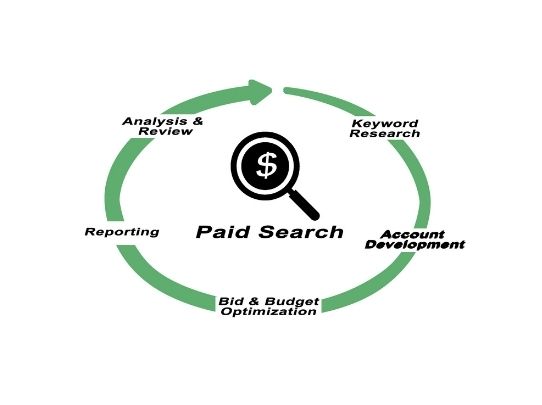
Paid search, often known as search engine marketing, is a digital marketing technique that involves purchasing advertising on search engines. Marketers may choose to pay either per click on their advertisement (referred to as pay per click or PPC) or per click on the display banner of the advertisement.
Generally, a professional team determines which platforms to invest in depending on where they feel the advertisement would get the greatest attention.
A possible distribution channel for this conventional kind of paid media is programmatic advertising, a kind of paid media that uses artificial intelligence to automatically purchase advertising space based on data about the audience to whom the advertisements should be targeted.
With an expected $46 billion spent on programmatic advertising in 2020, it is expected that by 2025, automation would show 86 percent of all digital display advertisements. This movement toward AI automation enables a more smooth, efficient, and precise approach to paid advertising, all while cutting client acquisition expenses. Paid search marketing will play a major role in the future.
To Recognize Photographs
Artificial intelligence-powered image identification software and tools assist in identifying a variety of photos in order to comprehend changes in a user's behavior or routine. It can sift through millions of photos using sophisticated algorithms to extract vital information.
Chatbots Powered by Artificial Intelligence
Businesses that operate on social media use AI-powered chatbots to quickly respond to client inquiries. By comprehending the purpose of an inquiry, AI-enabled chatbots may effectively conduct dialogues with users and supply them with the appropriate answers. Businesses may significantly enhance customer experience this way. Paid search advertising will be the way to go for small and medium businesses.
Sentiments Analysis
Because AI can assess the nature or purpose of a user's query, remark, or other action, it may assist marketers in identifying sentiments and determining how they feel. This is accomplished via the use of another subset of AI known as natural language processing. Additionally, NLP assists in identifying good and negative phrases inside a post or remark. Paid search ads are cost-effective when the ROI is calculated.
Enhanced Security
Artificial intelligence can assist social media companies in protecting user data and enhancing the privacy of their users' information. This technology may assist users in enhancing the security of their social media accounts via user authentication, pattern recognition, fraud protection, and other capabilities.
Artificial intelligence is assisting social media companies in managing and making sense of their data pool in order to understand the newest trends, user behavior, and interests, identify and prevent abusive material, and for a variety of other objectives.
It has a promising future in this market since it enhances user experiences and enables companies to provide better service to their customers. AI also plays a significant part in social media marketing by allowing firms to track their success and discover individuals who may be turned into consumers. You can always hire a paid search manager to handle all your Paid Search campaigns and SI tools.
DISCLOSURE: This post contains affiliate links, which means that if you click on one of the product links and make a purchase, I will receive a small commission. Which helps me support the channel to make quality content and recommend products for you.