The proportion of visitors to a website that leaves after reading just one page is referred to as the site's bounce rate. A high bounce rate may be an indication that the website does not provide a pleasant user experience or that the material on the page is not relevant to the visitor.
Both of these possibilities are possible explanations for the phenomenon. Conversely, a low bounce rate may suggest that the website is successfully engaging its users and offering a good experience for them.
Google takes a website's bounce rate into consideration as one of the elements when determining a site's overall rank. If your client's website has a high bounce rate, it indicates that visitors are not able to obtain the information they need there.
A high bounce rate may have a negative influence on a website's SEO results since Google's algorithm is continuously being updated to ensure that it is presenting the most relevant material to the most relevant audience.
However, it is important to realize that a high bounce rate is not always a red flag in every situation. There are several fields of business and types of websites in which a high bounce rate is unavoidable and should not be seen as a reason for worry.
Having said that, unless your website falls into that category (more on this topic will be covered later), a high bounce rate should urge you to do an analysis of the page, determine the origin of the issue, and work out how to remedy it.
For instance, if the typical bounce rate for websites in your sector is forty percent, but your own website has a sixty percent bounce rate, this may be a reason to be concerned.
In a similar vein, if you have certain objectives in mind for your website, and your website's bounce rate is high in comparison to other websites that provide a comparable service, then this might be an indication that something is wrong.
According to Jay, "the majority of websites will experience a drop in their bounce rates that ranges between 26% and 70%." "The average percentage of visitors who left the webpages in my sample set without navigating farther was 49%.
Why is it vital to consider the bounce rate?
Your page views after being navigated away are important. A high bounce rate almost certainly indicates that customers had a negative experience while visiting your website, which resulted in fewer site purchases as a direct result of those users. Understanding your site's bounce rate is essential to optimizing the conversion rate of your website.
In marketing parlance, websites have to have a "sticky" quality. Whether potential customer arrives at your website on their own or after being directed there, they should feel compelled to remain there. Customers are more likely to make a purchase from your business if they remain on your website for a longer period of time and examine it in more depth.
When determining who views your page, Google takes into account your page's bounce rate. It is a good sign that someone found the material on your website interesting and valuable if they spent the time to click through too many pages on the site.
How can we reduce the bounce rate?
Resolve the Technical Concerns
Web development challenges are often considered to be technical concerns. If your high bounce rate can be traced back to a software issue, such as a slow website with an unusually long load time, you should be able to resolve the issue with relative ease by employing a technical fix. For example, you could hire a developer to optimize your website navigation and other areas of your site, or you could purchase additional server space.
Optimize for mobile
Your website has to be readily accessible and navigable from mobile devices in light of the fact that more people are utilizing their phones to explore the internet than at any other time in history. When viewed on a mobile device, for instance, longer films might take a significant amount of time to load.
People are more likely to leave a page if they experience any form of latency when attempting to view it on their mobile devices. You may eliminate this kind of lag by using shorter videos on your mobile site.
The mobile version of your website has to be neat and succinct, providing consumers with the information that they want in a way that is both easy and fast to access.
Pay attention to entry points as well as user intent.
When people visit your website, it is essential to monitor where they came from before clicking through to your page.
They subscribed via your email newsletter, right? What about organic search? Public service announcements on social media? Suppose the bounce rate is very high for one of these sources. In that case, it may indicate that something at the source, such as your ad text or the title tag and meta description that appear in search results, needs to be modified in order to effectively deliver your message.
People are likely to leave your page if the advertisement they saw on Facebook does not adequately prepare them for what they will find when they visit your page.
Improve User experience
To provide a more positive experience for visitors to your website, you should make every effort to remove any elements of your site, such as the accessibility of your navigation, that might potentially distract or irritate people.
Someone is likely to flee the scene if, in rapid succession, they are confronted with a chatbot, a full-screen popup ad for your newsletter, and then a popup discount offer. It is important to be careful of the popups and advertisements that you use on your website and to find a way to integrate them without disrupting the user experience.
I am Krishnaprasath Krishnamoorthy, a business owner and managing director of Digital Nomad Ventures Pvt Ltd. I’m a seasoned digital marketing strategist specialising in the synergy between Social Media Marketing, SEO, and Digital Advertising. My career is dedicated to empowering businesses to achieve their growth objectives through AI-driven approaches that maximise online visibility and drive high-intent traffic. For enquiries, WhatsApp or call me on +94 775 696 867
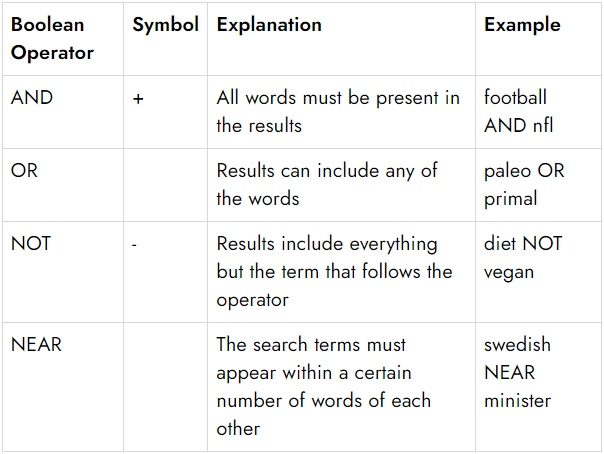
In the context of using a search engine, a Boolean search refers to a sort of search in which you may narrow, broaden, or define your search by using specialized words or symbols. Boolean operators like AND, OR, NOT, and NEAR, in addition to the symbols + (add) and - (subtract), make this a realizable goal (subtract).
When you use an operator in a Boolean search, you are either providing flexibility to acquire a larger variety of results or you are specifying constraints to lower the number of irrelevant results. This may happen either way, depending on the operator you choose.
When searching on Google, use the AND operator to look for all of the search phrases that you give. When you use AND, you can be certain that the subject you are studying will be the subject you see in the search results.
All of the main programming languages include Boolean algebra since it is an essential part of contemporary computing and because of its widespread use. In addition to that, it plays a significant role in statistical techniques and set theory.
The majority of modern database searches are conducted using Boolean logic, which enables us to define parameters in more depth. For instance, we may combine search phrases in order to include certain results while rejecting others. Concepts related to Boolean logic are applicable to the internet as well given that it is comparable to a massive collection of information databases.
When you do a standard search, for example, "cat" if you want to find images of canines, you will obtain a huge number of results possibly even in the billions. If you are seeking a certain cat breed or if you are not interested in seeing photographs of a specific sort of cat, a Boolean search might be helpful in this case for finding what you are looking for.
You might use the NOT operator in place of manually sorting through all of the cat photographs in order to filter out images of Persian cats and Birman from the results. After you have completed a standard search, it is quite beneficial to do a Boolean search.
For example, if you run a search and it returns lots of results that pertain to the words you entered but don't actually reflect what you were looking for, you can begin introducing Boolean operators to remove some of those results and explicitly add specific words.
This can be done if you run a search that returns lots of results that pertain to the words you entered but don't actually reflect what you were looking for. In order for a search engine to recognize a Boolean operator, the term must be written entirely in capital letters.
Otherwise, it will just be treated as a normal word. Any term that starts with a root or stem that is truncated by an asterisk will be returned, regardless of whether the asterisk was used to represent a root word, a stem word, or a truncation. Because of this, the asterisk is a time-saver that enables you to avoid writing out lengthy and intricate search keywords.
Inserting the Boolean Search Operator NOT before the term or phrase you wish to exclude from the search results. By surrounding a search word or phrase with quotation marks, you may restrict the scope of your search to just that term or phrase. If you omit the quotation marks, the results that your search engine returns may include all of the results that include each individual term.
I am Krishnaprasath Krishnamoorthy, a business owner and managing director of Digital Nomad Ventures Pvt Ltd. I’m a seasoned digital marketing strategist specialising in the synergy between Social Media Marketing, SEO, and Digital Advertising. My career is dedicated to empowering businesses to achieve their growth objectives through AI-driven approaches that maximise online visibility and drive high-intent traffic. For enquiries, WhatsApp or call me on +94 775 696 867
Accessing a web-based software application or web utility requires the use of something called an application programming interface (API), which is a collection of programming instructions and standards. A software firm makes its application programming interface (API) available to the general public so that other software developers may create products that are powered by the software company's service.
For instance, online shopping for electronics, apparel, computers, books, DVDs, and more developed its application programming interface (API) in order to make it simpler for developers of websites to access the product information that Amazon provides. Using the Amazon Application Programming Interface (API), a third-party website may provide direct links to Amazon items with an option to "purchase now" and updated pricing.
An application programming interface, or API, is not an interface that is used by end users. When APIs are used, applications are able to communicate with one another without the need for user involvement or knowledge.
When you purchase movie tickets online and submit your credit card information, the website where you bought the tickets utilizes an application programming interface (API) to transmit your credit card information to a remote application that checks to make sure that the information you entered is accurate.
After the transaction has been successfully completed, the remote application will then transmit a response to the website selling movie tickets, indicating that it is OK to distribute the tickets.
You, as a user, are only presented with a single interface, which is the website for purchasing movie tickets; yet, behind the scenes, a number of apps are collaborating with one another through application programming interfaces (APIs). When software functionalities are transferred from one application to another, seamless integration occurs since the user is not aware that this transition is taking place [source: TConsult, Inc.].
The application programming interface (API) is analogous to the software delivery model known as software as a service (SaaS), in which programmers do not need to begin each new project from the ground up. Instead of designing one core application that attempts to accomplish everything, such as e-mail, billing, tracking, etc., the same program may contract out specific functions to distant software that does it better.
The Mechanisms Behind Application Programming Interfaces
In general, an application programming interface (API) enables a software program to connect with a distant application via the internet by means of a sequence of calls that may be initiated from either the local or remote application. An application programming interface (API) is an interface because, by definition, whatever describes the method in which two things interact is an interface.
Web services are used to handle the calls going back and forth between apps when using APIs. APIs stand for application programming interfaces. Web services are a group of technical standards and protocols that include XML (Extensible Markup Language), which is the programming language that apps use to interact with one another via the internet.
What exactly is the function of an API?
The majority of the time, a web browser is a medium via which an end user, or a living, breathing person, engages with the digital services provided by a corporation. The information that was requested is then rendered by the service provider into HTML so that it may be shown in the browser.
HTML is a presentation language, and because it is formally quite relaxed (even badly written HTML usually displays quite well in most browsers), it is not at all suitable to be consumed by machines that simply need to exchange data in a reliable manner. This is because HTML is a presentation language.
Instead, the corporation provides a more formal Application Programming Interface, often known as an API, so that it may be accessed and utilized by other apps, such as those coming from a partner, client, or supplier. This might be done in addition to the typical graphical web interface.
Generally speaking, the communication protocol, such as HTTP, as well as the format of the requests (messages sent from the client application) and the replies (messages sent from the server side back to the client), are both sets and described in some type of standard specification.
Common use cases include an online travel booking site that requests information about available flights from more than fifty different airlines, a website that allows you to log in by using your Google or Facebook account, or a customer relationship management system that, when you add a new customer, automatically retrieves credit ratings about the customer from an external subscription-based rating service.
What are the advantages of working with an application programming interface (API)?
An application programming interface, or API, is a collection of computer instructions that outlines how different software components need to collaborate with one another. It enables the separate components to communicate information with one another and also makes it possible to reuse those components in multiple applications.
There are many different applications for application programming interfaces (APIs), but one frequent usage is to provide permission to third-party developers to access the data or functionality of another application.
For instance, Facebook provides developers with an API that enables them to build applications that have access to the data of Facebook users. This makes it possible for developers to build new and unique products without having to begin completely from scratch each time.
One further advantage of using the use of an API interface is that it may assist in lessening the quantity of code that must be created. By reusing code that has already been developed, it is possible to cut down on both development time and expenditures.
In addition, application programming interfaces (APIs) may assist make programs more dependable by cutting down on the number of dependencies they have on outside services. The use of an API interface may, in general, result in various advantages, such as enhanced flexibility, decreased development time and costs, and better dependability.
I am Krishnaprasath Krishnamoorthy, a business owner and managing director of Digital Nomad Ventures Pvt Ltd. I’m a seasoned digital marketing strategist specialising in the synergy between Social Media Marketing, SEO, and Digital Advertising. My career is dedicated to empowering businesses to achieve their growth objectives through AI-driven approaches that maximise online visibility and drive high-intent traffic. For enquiries, WhatsApp or call me on +94 775 696 867
A hyperlink that leads to a complete URL is known as an absolute link. A full URL contains all of the information that is necessary to locate a specific website, page, document, or another addressable object on the Internet.
These items are included in this information: The protocol that should be used, such as the Hypertext Transfer Protocol (HTTP) or File Transfer Protocol (FTP), (File Transfer Protocol).
If we are speaking in terms of search engine optimization (SEO), then absolute URLs are greatly preferable to relative URLs. This is due to the fact that relative URLs may be confusing for Google bots, and if we are speaking in terms of less sophisticated bots, then it may not even be crawled.
This information consists of the following: -
The protocol that will be used, such as the hypertext transfer protocol (HTTP) or the file transfer protocol (FTP) (file transfer protocol).
The address, or domain name, of the website where the object being searched may be found.
The directory or subfolder in the domain where the object is being requested may be found if it is located there.
The name of the item's file, if relevant, will often include the extension that designates the kind of item (HTML file, PDF file, image file, video, etc).
They never fail to be one of a kind. This means that there is one and only one absolute link for each and every individual copy of a document, as well as each and every specific page and directory on the internet. When we talk about optimizing your website so that it can be crawled by Search Engine Bots, we recommend using an absolute URL.
This is because if the bots do not receive all of the information they need about your URL, they may display an error message. This error message could be the cause of an increase in your bounce rate or a loss of visitors.
I am Krishnaprasath Krishnamoorthy, a business owner and managing director of Digital Nomad Ventures Pvt Ltd. I’m a seasoned digital marketing strategist specialising in the synergy between Social Media Marketing, SEO, and Digital Advertising. My career is dedicated to empowering businesses to achieve their growth objectives through AI-driven approaches that maximise online visibility and drive high-intent traffic. For enquiries, WhatsApp or call me on +94 775 696 867
A/B testing, also known as split testing, is a process that compares two versions of a web page or app against one another to see which one works better. This testing approach is also known as "A/B testing."
How to Conduct A/B Testing
Pick one variable to test
Identify your goal
Create a 'control' and a 'challenger
Split your sample groups equally and randomly
Determine your sample size (if applicable)
Decide how significant your results need to be
Make sure you're only running one test at a time on any campaign
More often than not, A/B testing is applied in UX rather than content. The initial effect of SEO will be difficult to assess. When you try out the user experience, however, you run the risk of hurting your SEO efforts due to the generation of duplicate material. To circumvent this, you should make use of canonicals. The simple truth is that A/B testing has NO bearing whatsoever on search engine optimization.
The reason for this is that search bots do not run JavaScript, which is the way that the vast majority of A/B testing software employs. In addition, Google does A/B testing on its own and offers a tool specifically designed for doing such testing; thus, it is reasonable to believe that the company is well aware that other businesses also conduct such testing.
Therefore, it is quite unlikely that Google or any other search engine would punish you for doing A/B testing. You could wish to exclude search bots from your testing as a precaution, but in all honesty, doing so is not really essential since the vast majority of search bots will only view the original version of your website and not the variant.
Taking into account the conditions that you specified, the findings of the test would be unremarkable. Changing one term for another will not provide any data regarding how well your optimization is working. There is a wide range of competitiveness and search traffic associated with each individual word.
Therefore, even if you have a lower ranking for a term that has a much greater volume, you may still get more overall traffic. Because the gap between volume and competitiveness in your particular example is so wide, doing an A/B test is a waste of time that prevents you from focusing on the productive activities that may help you get a higher ranking for your desired phrase.
Testing using the A/B method demonstrates whether or not certain modifications are successful, which paves the way for choices to be guided by data and guarantees positive results.
Benefits of doing A/B tests for your website
An elevated level of participation from end users
A/B testing may be performed on a variety of parts of a web page, app, advertisement, or email, including the title or subject line, images, call-to-action (CTA) forms and wording, layout, typefaces, and colors, among other things. One update at a time will disclose which changes had an influence on the behavior of the users and which ones did not. The user experience as a whole may be improved by implementing the "winning" modifications, which will also make it possible to optimize the experience so that it is successful.
An improvement in the overall content quality
For instance, while testing several versions of an advertisement's wording, you'll need a list of possible enhancements to display to consumers. The process of creating, reviewing, and evaluating these lists helps reduce inefficient language, which ultimately results in versions that are easier to use.
A decrease in the bounce rate
A/B testing is a method that involves comparing two versions of a website or app in order to determine which version is more successful at keeping people engaged for longer periods of time. People have a greater chance of recognizing the value of the content on your website and making a purchase when they stay on it for longer periods of time.
An increased rate of conversion
A/B testing is the easiest and most effective method for determining which content has the most potential to convert site traffic into sign-ups and sales respectively. The conversion of more leads is helped by having a better understanding of what works and what doesn't work.
An increase in the percentage of sales made
The insights gained from doing A/B testing on a single experience may be used to other experiences, such as the pages used to market more expensive products and services. The level of user interaction on these sites must be enhanced in order to see an increase in conversions.
The ease of analytical interpretation
In an A/B test, choosing a victor and a loser is as easy as determining which website or app's metrics are the most closely aligned with the test's primary goals (time spent, conversions, etc.,). Despite the fact that testing services have evolved to provide statistical analysis for customers with differing degrees of knowledge in spreadsheets, the calculations involved in comparing two different experiences are rather straightforward.
Results obtained quickly
In an A/B test, even a small sample size may provide relevant and actionable information regarding which changes consumers find more engaging. This is because the test compares two versions of the same thing. It is now possible to do on-demand optimization of newly launched websites and applications as well as pages with a poor conversion rate.
Anything and everything can be put to the test.
Forms, images, and text are the components of a website or app that are most often subjected to A/B testing and updates; however, any component of the page or app may be modified and put to the test. If you don't test the formatting of your headlines, the colors of your call-to-action buttons, the length of your forms, and any number of other aspects.
You'll never know how these elements affect user engagement and conversion rates. During a conference call, there is no need to dismiss any ideas or suggestions; tests and measures, not feelings, are what define what succeeds and what fails.
There is a reduction in the risks involved
Testing using A/B may assist you to avoid making tweaks that end up being time-consuming and expensive even if they were initially successful. Important choices may be made with enough information, which allows for the avoidance of mistakes that are both time and money intensive and that would otherwise result in little or no reward.
A reduction in the number of shopping carts that are abandoned
Convincing a user to finish the checkout process after clicking "buy" on an item is a significant challenge in e-commerce since the majority of prospective customers abandon their shopping carts before paying for their purchases. A/B testing is a useful tool for discovering the optimal combination of order page tweaks that will bring users all the way to the end of the process.
A boost in sales
Increased sales volume is a direct result of all of the benefits of A/B testing that have been discussed so far. In addition to the immediate sales boost that optimal modifications provide, testing enhances user experiences, which in turn develops confidence in the brand, which in turn results in loyal, repeat customers, which in turn results in greater sales.
I am Krishnaprasath Krishnamoorthy, a business owner and managing director of Digital Nomad Ventures Pvt Ltd. I’m a seasoned digital marketing strategist specialising in the synergy between Social Media Marketing, SEO, and Digital Advertising. My career is dedicated to empowering businesses to achieve their growth objectives through AI-driven approaches that maximise online visibility and drive high-intent traffic. For enquiries, WhatsApp or call me on +94 775 696 867