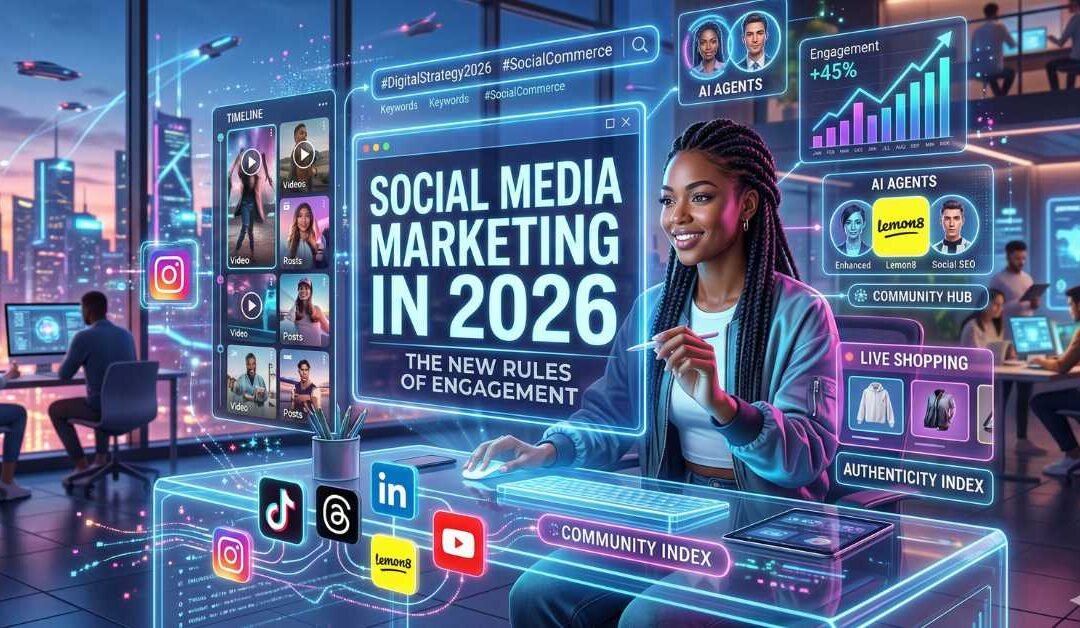
Social media has completely changed. If you are still running your marketing the same way you did in 2023, you are likely falling behind. The landscape of 2026 is no longer about getting the most “likes.” It is about understanding how robots (algorithms) discover new things and how humans find deep, real connections.
The days of simply posting a pretty picture are gone. Today, social media is an intricate system of artificial intelligence, search behaviours, and private communities. To succeed, you must move beyond managing simple platforms. You must become a director of an AI-driven environment and a builder of high-trust communities.
This article will break down the latest trends and technologies in social media marketing, explained in simple language so you can start applying them today.
Part 1: The Core Trends Driving Success
The core strategy of how we use social media is shifting. Here are the three main behaviours defining the market right now.
1. Social SEO: Social Media is the New Search Engine
Remember when you used to type everything into Google? For younger generations, especially, that behaviour is changing rapidly. People are now using platforms like TikTok, Instagram, and Reddit as their primary search engines.
Why? Because they want visual proof. They don’t want a written list of the “best new pizza place” from an anonymous website. They want to see the pizza, the atmosphere, and a real person eating it. They are searching for reviews, tutorials, and local discoveries directly on social apps.
What This Means for You: Your focus must shift from “going viral” to “being discoverable.” When someone searches for a product or service you offer, you need to make sure you show up. This is called Social SEO (Search Engine Optimisation).
How to Do It:
- Keywords Everywhere: Use important search terms (keywords) not just in your hashtags, but in your captions and your profile bio.
- On-Screen Text: The robots can “read” text overlaid on your videos. Use your keywords in your titles.
- Spoken Word: Algorithmic systems listen to what is said. Make sure you clearly speak your main keywords in the first few seconds of your video.
2. The Battle for Authenticity vs. “AI Slop”
We are now living in a world of abundant artificial intelligence. It is incredibly easy to generate “perfect” content. You can make an AI image of a flawless product or an AI-written caption that is technically correct. The problem is, everyone is doing it. This creates a feed full of “AI Slop”—content that looks fine but has no soul.
Because audiences are drowning in this generic content, they are actively looking for something else: the human touch. They are gravitating toward unpolished, real, and imperfect content. A shaky, behind-the-scenes video or a simple meme often performs better than a $10,000 commercial because it signals “human origin.”
What This Means for You: You must emphasise the real people behind your brand. Trust is the most valuable currency on social media, and you build it by being human.
How to Do It:
- Behind-the-Scenes: Show the messy office, the prototype that failed, or your team having lunch. This feels real.
- User-Generated Content (UGC): Encourage your customers to share unedited videos of themselves using your product. This is far more trustworthy than an ad.
- Creator-Led Strategy: Move away from paying influencers for one-off posts. Instead, form long-term partnerships with creative people in your niche. Let them be the face of your brand and create content that speaks to their community in their unique voice.
3. Community Over Reach (The Rise of Dark Social)
For years, the goal was simple: get as many people as possible to see your post. In 2026, raw numbers are less important. Why? Because the most active conversations have moved. Public feeds are becoming passive places where people scroll, but they aren’t interacting. The “real action” is happening in private.
This is often called “Dark Social” because it is hard for companies to track. It includes:
- Direct Messages (DMs).
- Group chats on platforms like WhatsApp or Discord.
- Instagram Broadcast Channels (one-to-many chats).
People trust the recommendations they get in their DMs far more than they trust a post in their feed.
What This Means for You: You need to stop focusing on how many people you reached and start focusing on how many people you got to talk. You want to encourage private interaction.
How to Do It:
- Use DMs: Create content that specifically asks users to “DM me the word [KEYWORD], and I’ll send you a special link.” This starts a private conversation.
- Create Broadcast Channels: This is a great way to talk directly to your superfans and share exclusive information.
- Serialized Content (Micro-dramas): Create short stories that are released in parts. This gives users a reason to keep coming back to your page, making your brand feel like a familiar friend rather than a broadcast signal.
Part 2: The New Technologies You Must Understand
If the trends above are the strategy, these technologies are the tools that make that strategy possible.
1. Agentic AI & Embedded Workflows
We have used AI for years, but usually as a simple assistant (like asking ChatGPT to write a caption). Now, we are moving into Agentic AI. This means the AI isn’t just a tool; it is an “agent” that can perform entire multi-step jobs on its own.
This AI is embedded directly into marketing systems to manage your workflow.
What This Means for You: It can do the boring, repetitive tasks, freeing you up to be the creative director.
How to Do It:
- Automated Scheduling: You give the AI your core concept and a library of images/videos. The AI analyses real-time data to decide the perfect time to post across different platforms, scheduling them all at once.
- Multimodal Content: A tool can now take one single idea (like a 3-minute blog post) and automatically turn it into:
- A 60-second vertical video (Reel/TikTok style).
- A 16:9 widescreen video (YouTube style).
- A slideshow post (LinkedIn Carousel style).
- The best part? It can do all this while ensuring the visuals (like brand colours and character designs) stay perfectly consistent.
2. Immersive Social Commerce
Online shopping is no longer about seeing a photo and clicking a “link in bio” that takes you to a confusing website. Shopping has now become a single, seamless journey entirely within the social media app.
What This Means for You: You need to make the purchase as easy as possible, reducing any friction that might make a customer change their mind.
How to Do It:
- AR & 3D Previews: Augmented Reality (AR) is now standard. Customers can use their phone’s camera to do virtual “try-ons” of makeup, eyeglasses, or clothing. They can even place a 3D model of a sofa in their actual living room to see if it fits. This makes people feel more confident to buy and reduces the number of returns.
- Live Commerce 2.0: Livestream shopping has evolved. These are now interactive, shoppable broadcasts (like TikTok Shop or Instagram Checkout). A host can demonstrate the product, answer questions in the chat in real-time, and a “buy now” button pops up on the screen. The user buys the product instantly without ever stopping the stream.
3. Conversational AI Commerce
The chatbots of the past were frustrating. They could only understand a few basic commands and often got stuck. The new conversational AI is different. It is powered by Large Language Models (LLMs), similar to how ChatGPT works, but specialised for sales.
What This Means for You: You have a human-like virtual sales assistant working for you 24 hours a day, 7 days a week.
How to Do It:
- Deep Personalization: These advanced bots don’t just answer FAQs. They can have complex conversations. If a user says, “I’m looking for a gift for my teenage brother who loves video games and dark colors,” the AI can offer specific, tailored recommendations.
- DMs to Sale: The bot can handle the entire sales process. It answers product questions, provides a personalised suggestion, and completes the entire checkout process right there within the DM or WhatsApp thread.
Part 3: A Quick Look at Key Platforms in 2026
Where you post is just as important as what you post. Here is how the major players fit into the ecosystem.
- TikTok (and TikTok Shop): This is the ultimate discovery and commerce platform. The funnel has collapsed: discovery, review, and purchase can all happen in the same 30 seconds.
- Instagram: Still a powerhouse for aesthetic content, but it is split between public reels and private interactions. High-trust relationships are built in the DMs and broadcast channels.
- LinkedIn: It has completely changed. It is no longer just a place for resumes. It has become a dominant video content platform. Native video posts now see significantly higher engagement (around 5x more) than simple text-only posts.
- Threads: This is the conversational layer connected to Instagram. It is currently seeing high growth for text-first, opinion-driven, and quick-response content. It is less polished and more conversational than traditional feeds.
- Lemon8: This is gaining traction as a hybrid of Instagram and Pinterest. It focuses on aesthetic, blog-style content about lifestyle and wellness. Think of it as a “visual diary” platform.
Focus on Trust, Led by Tech
The world of social media marketing is always shifting. New tools like AI can write captions, create entire video clips, and manage your schedule. New trends can push you to make more raw videos or to optimise your captions for search.
But amidst all this change, one thing remains true: successful marketing is about human connection.
The technologies listed here are not replacements for your marketing strategy; they are enhancers. Agentic AI doesn’t remove the need for creative direction; it frees you from administrative tasks so you can be a director. Live commerce doesn’t replace trust; it just provides a faster, easier way for people to buy from a brand they already trust.
The secret to success in 2026 is simple: use technology to be more human, and use algorithms to find the community that has been waiting for you. Focus on building trust, encouraging real conversations, and making your brand easily discoverable. The rest will follow.
Leave a Reply