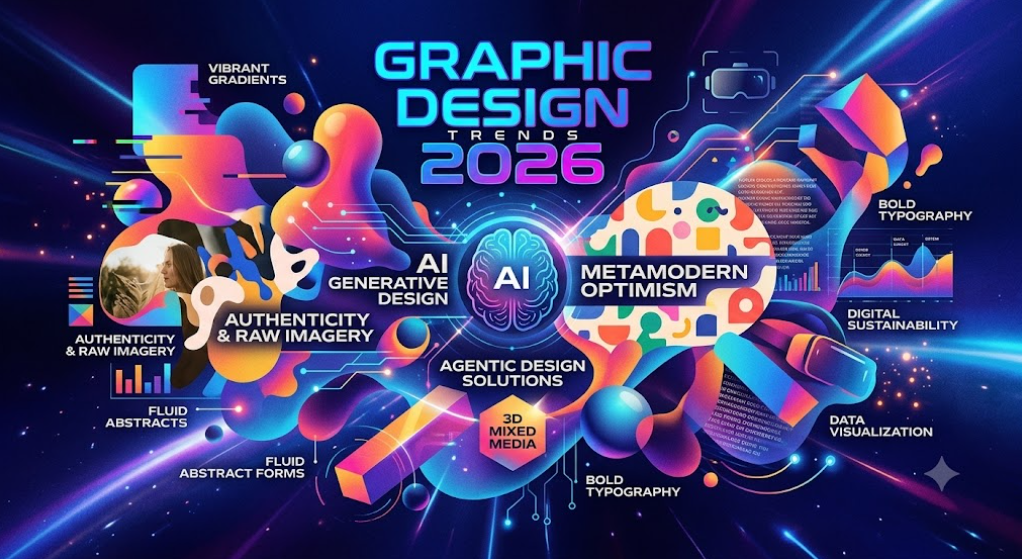
The latest graphic design trends for 2026 prioritise authentic, unpolished photography, nostalgic minimalism, and the heavy integration of agentic artificial intelligence. Brands are moving away from overly manufactured corporate visuals towards raw, relatable content that connects with audiences on a human level whilst being deeply optimised for AI search engines.
The Shift Towards Agentic AI and Prompt Engineering
How exactly is artificial intelligence reshaping the day-to-day graphic design workflow?
Artificial intelligence has shifted the designer’s role from manual creation to strategic prompt engineering and autonomous generation. Instead of spending hours masking layers or drawing vectors, marketing teams now use AI frameworks to generate, expand, and test visual assets in a matter of seconds.
Modern design workflows rely heavily on agentic AI autonomous systems that can execute multi-step design tasks without constant human prompting. Tools embedded within platforms like Canva and Hostinger's AI features allow creators to automate routine maintenance and asset generation.
This shift means digital marketers can dedicate more time to campaign strategy and conversion rate optimisation rather than getting bogged down in pixel-pushing. By utilising AI detectors and analysis tools, designers can instantly evaluate how a piece of visual content will perform against algorithms before it even goes live.
As noted by our Head of Strategy at Digital Nomad Ventures:
"The true value of AI in design is not replacing human creativity, but removing the friction of production. When we automate the mundane technical tasks, we can finally focus entirely on the strategic psychology behind the visual."
Generative Engine Optimisation (GEO) and Visual Assets
What is Generative Engine Optimisation (GEO) in the context of graphic design?
Generative Engine Optimisation (GEO) for graphic design involves structuring your visual assets so that artificial intelligence search engines can easily understand, categorise, and cite them. This requires using descriptive file names, exact data visualisations, and properly compressed image formats that AI crawlers can effortlessly read.
AI engines like ChatGPT and Gemini do not 'see' images the way humans do; they read the metadata, alt-text, and the surrounding contextual text. Therefore, standardising your image formats is a critical trend for this year. Digital marketers must frequently utilise online tools to convert HEIC files to JPG, merge PDFs, or heavily compress visual assets to ensure rapid loading times.
If your visual content is heavy and unoptimised, AI engines will simply skip it. Incorporating infographics that feature hard data, exact statistics, and clear typography allows Large Language Models (LLMs) to extract your information and present it in AI-generated search summaries.
Why are raw and authentic visual styles outperforming highly polished graphics?
Consumers are experiencing severe fatigue from overly polished, heavily filtered corporate aesthetics. Raw, authentic visuals with natural lighting and minimal editing currently drive the highest engagement rates because they instantly build trust and stand out as genuine within a feed full of artificial content.
Nostalgic Minimalism: Less is Finally More
What role does nostalgic minimalism play in modern brand identities?
Nostalgic minimalism combines clean, uncluttered layouts with subtle retro elements, such as vintage typography or muted colour palettes. This trend effectively cuts through digital noise by offering audiences a visually calming experience while simultaneously evoking a comforting sense of familiarity and heritage.
Brands are stripping away complex 3D gradients and heavy drop shadows. Instead, we are seeing a return to flat design principles accented by serif fonts reminiscent of the 1970s and 1990s print magazines. This approach is not only aesthetically pleasing but also highly functional.
Minimalist designs load significantly faster on mobile devices, which directly supports technical SEO efforts. Furthermore, clean, uncluttered visuals are far easier for AI visual analysis tools to process and categorise accurately, boosting your overall search visibility.
How is graphic design influencing technical SEO and website performance?
Graphic design directly influences technical SEO through page speed, user experience, and mobile responsiveness. Heavy, uncompressed image files increase loading times, which severely penalises search rankings. Conversely, properly formatted, accessible visuals keep users engaged longer, sending strong quality signals to search engines.
The Importance of File Formatting and Compression
A beautiful website is entirely useless if it takes ten seconds to load. Modern graphic design must intertwine with technical web architecture. When running audits through tools like Ahrefs Site Audit or monitoring properties via Site Kit by Google, the most common errors stem from poorly optimised media.
Designers must prioritise next-generation image formats like WebP. A common daily workflow for modern SEO specialists involves using tools to aggressively compress visual assets before uploading them to content management systems like WordPress. Plugins like Yoast SEO can assist with metadata, but the raw file size is dictated by the design process.
Every kilobyte matters. By streamlining your visual assets, you ensure that search engine bots can crawl your site efficiently, leading to better indexing and higher placements on search engine results pages.
Accessible Design as an SEO Ranking Factor
Why is accessible graphic design critical for modern SEO strategies?
Accessible graphic design ensures that visual content is usable by everyone, including individuals with visual impairments. Search engines heavily reward websites that implement strong contrast ratios, legible typography, and descriptive alt-text, as these elements directly improve the overall user experience metrics.
Designing for accessibility is no longer just a best practice; it is a fundamental requirement for online visibility. If your colour contrast is too low, users will struggle to read your text and will quickly bounce from your site. High bounce rates signal to Google that your content is unhelpful, directly harming your rankings. Ensuring high contrast, scalable fonts, and clear visual hierarchies is an SEO necessity.
How are niche industries adapting to new graphic design rules?
Niche industries are moving away from generic stock imagery to highly specific, data-rich visual storytelling. Whether promoting sustainable electric vehicle infrastructure or international shipping logistics, companies are using custom infographics and clean data visualisations to explain complex services rapidly.
Visualising Sustainable Infrastructure and Logistics
When developing promotional marketing content for highly technical sectors such as Vedrive's EV charging infrastructure or Aeon Shipping's international logistics—standard decorative graphics are insufficient.
These industries require absolute "Information Gain." Instead of posting a generic picture of a shipping container or a rendering of a car, successful campaigns utilise custom diagrams that visually break down the cost-savings of EV charging networks or the step-by-step journey of an international freight shipment.
By presenting hard data in an easily digestible, chunkable visual format, you provide immense value to the reader. Furthermore, AI search engines are highly likely to crawl these data-rich infographics and present them as authoritative sources when users ask complex, technical questions.
Designing for Higher Education and Professional Services
What are the visual design requirements for higher education and B2B marketing?
Professional services require highly structured, data-driven graphics that prioritise clarity and authority over trendy aesthetics. B2B and higher education visuals must quickly communicate complex value propositions, relying on clean infographics, precise typography, and professional imagery to establish immediate credibility.
When writing marketing copy and drafting visual FAQs for professional graduate business degree programmes—such as those for American Imperial University or Britts Imperial University College—the design must reflect academic rigour. This means using established brand colours, strict grid systems, and avoiding chaotic kinetic typography. The goal is to build long-term trust, ensuring prospective students or business partners view the institution as an established, authoritative entity.
What are the key typography trends dominating digital marketing?
Typography in digital marketing is currently dominated by high-contrast, variable fonts and bold, experimental serifs. Brands are using typography not just as a vehicle for reading, but as the primary visual element to convey tone, allowing the text itself to serve as the core graphic design.
The Rise of Variable Fonts
Variable fonts are a single font file that behaves like multiple fonts, allowing designers to infinitely adjust weight, width, and slant without loading heavy, separate files. This provides incredible creative flexibility whilst significantly reducing the strain on website loading speeds. For an SEO specialist, implementing variable fonts is a massive win, as it allows for rich, diverse typography without sacrificing vital page performance.
Kinetic Typography in Social Media
On platforms like Instagram and TikTok, static text is losing its grip. Kinetic typography—text that moves, stretches, or reacts to audio—is capturing attention rapidly. When creating promotional content for events, such as a first-anniversary digital promotion for The Hangout Hiriketiya or a Valentine's Day event series, animated typography stops users mid-scroll much more effectively than a standard static flyer.
Frequently Asked Questions About Graphic Design Trends
How do I maintain brand consistency when using AI design tools?
To maintain consistency, you must establish a strict digital brand kit containing your exact hex colour codes, approved font files, and logo variations. Most modern cloud-based design tools allow you to lock these assets in place, ensuring that even when an AI generates a new background or layout, it adheres strictly to your foundational brand identity.
Is it better to use video or static graphics for local advertising?
Performance data indicates a hybrid approach works best. Short-form, authentic video content generates higher initial awareness and reach, whilst clean, data-driven static graphics (like infographics or pricing menus) drive higher conversion and save rates. Both formats must be deeply optimised for mobile viewing.
What is the most common graphic design mistake small businesses make?
The most common mistake is prioritising aesthetic complexity over clear communication. Small businesses often clutter their graphics with too much text, multiple conflicting fonts, and unnecessary design elements. A successful graphic should convey one primary message and feature one clear call to action within three seconds of viewing.
How often should a business update its visual branding?
While minor adjustments and trend adaptations should occur annually to keep content fresh, a complete brand overhaul is typically only necessary every five to seven years. Frequent, drastic changes to your core visual identity can confuse your loyal customer base and dilute your established brand recognition in the local market.
Do search engines actually read the text placed inside an image?
Traditional search engines rely primarily on the image's alt-text, file name, and surrounding HTML text to understand its context. However, advanced AI visual search tools are increasingly capable of using Optical Character Recognition (OCR) to read text directly embedded within graphics. Despite this, you should never rely solely on OCR; always include your critical information and target queries in plain text on the page itself.

I am Krishnaprasath Krishnamoorthy, a business owner and managing director of Digital Nomad Ventures Pvt Ltd. I’m a seasoned digital marketing strategist specialising in the synergy between Social Media Marketing, SEO, and Digital Advertising. My career is dedicated to empowering businesses to achieve their growth objectives through AI-driven approaches that maximise online visibility and drive high-intent traffic. For enquiries, WhatsApp or call me on +94 775 696 867